

Search Places to Stay & Save
Most travelers assume the best car rental company 2026 comes down to price alone. That logic breaks down the moment a desk agent in Málaga or Miami tries to sell you $400 of duplicate insurance you already own, or when a microscopic door chip becomes a $600 dispute three months after you return home. Rental pricing has become increasingly opaque since 2024, with base rates advertised at one level while mandatory fees, insurance upsells, and damage claim practices drive actual costs far higher.
The gap between advertised rates and final checkout totals now regularly exceeds 150-200% for unwary travelers. This isn’t accidental. Industry consolidation has created pricing power that most rental companies exploit through desk-level pressure tactics and contractual ambiguity. Post-pandemic supply constraints have only accelerated these practices.
Understanding which rental companies operate transparently—and which ones treat customer interactions as revenue opportunities—requires looking past marketing claims to actual operational patterns. Booking data, complaint volumes, and standardized testing reveal stark differences in how major providers handle everything from damage documentation to refund processing.
Why Most Car Rental Comparisons Fail Travelers
Traditional rental company reviews focus on fleet quality and desk wait times. Those factors matter, but they miss the financial mechanisms that determine whether you’ll pay $300 or $900 for the same week-long rental. The real differentiation happens in three areas most comparison content ignores: insurance bundling transparency, damage claim procedures, and refund dispute resolution timelines.
Companies like AutoReisen and Cicar (both operating primarily in the Canary Islands) consistently rank highest in independent satisfaction surveys not because their cars are newer or their service faster, but because their pricing includes comprehensive coverage upfront. There’s no insurance upsell opportunity because full protection is mandatory and already factored into the advertised rate. When travelers compare a $35/day AutoReisen rental to a $22/day Goldcar option, they’re not comparing equivalent products—the Goldcar rate almost always excludes collision damage waiver, theft protection, and additional driver fees that add $25-40 daily once you’re at the counter.
This structural pricing difference explains why low-advertised-rate providers like Goldcar and SurpriceCarRental frequently appear at the bottom of satisfaction rankings despite having acceptable vehicle fleets. The business model depends on conversion at the desk, where language barriers, time pressure, and travel fatigue create optimal conditions for selling marked-up insurance products.
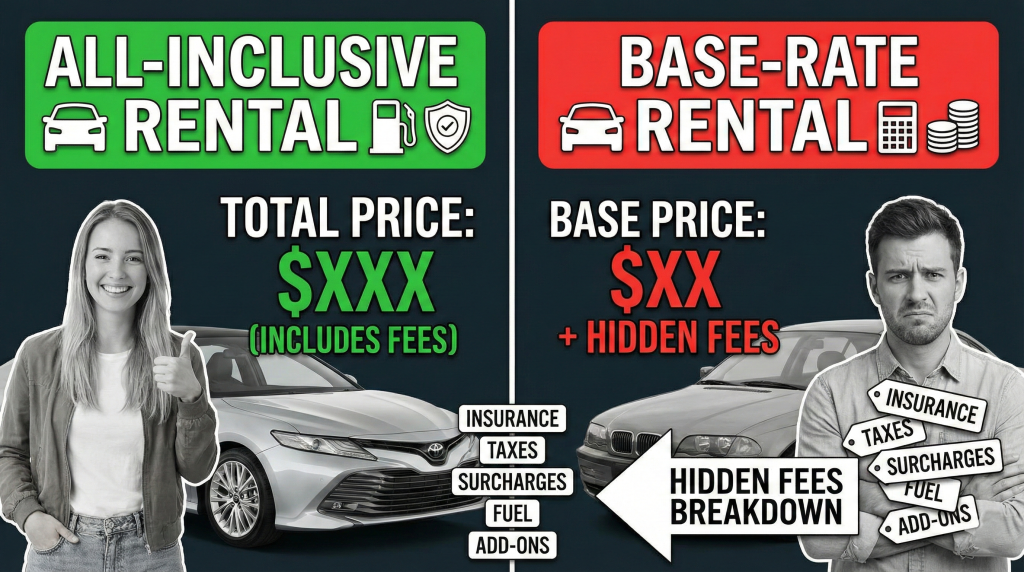
Companies operating in the mid-tier—Enterprise, Alamo, Hertz—typically offer optional insurance packages online during booking, giving travelers the ability to secure coverage at below-desk-rate pricing before arrival. This represents a meaningful improvement over pure desk-conversion models, though it still requires travelers to navigate multiple insurance options and understand the difference between collision damage waiver, supplemental liability, personal effects coverage, and loss damage waiver.
The complexity isn’t accidental. Rental companies profit significantly from insurance products, with desk conversion rates often exceeding 40% even when travelers already hold duplicate coverage through credit cards or third-party policies. Staff commission structures incentivize aggressive insurance sales, creating the pressure tactics that have drawn regulatory attention in Spain, Portugal, and other major rental markets.
How Rental Companies Actually Make Money (and What That Means for You)
Base rental rates cover fleet acquisition, maintenance, and basic operational costs. Most rental companies operate on thin margins from vehicle rental alone—typically 8-15% before insurance and fee revenue. The profit structure becomes clear when you examine where supplemental revenue comes from: insurance products generate 35-45% margins, additional driver fees cost the company nothing but collect $10-15 daily, and damage claims often recover 200-300% of actual repair costs through administrative fees and claim processing markups.
This explains why certain companies appear cheaper initially but rarely deliver lower final costs. A provider advertising $18/day might generate $45/day in actual revenue once mandatory airport fees, insurance conversions, fuel service charges, and damage claim frequency are factored in. Meanwhile, an all-inclusive provider at $35/day might actually cost less because no supplemental charges exist beyond optional add-ons like GPS or child seats.
The damage claim mechanism deserves particular attention. When you pick up a rental car, the agent walks around the vehicle noting existing damage. The thoroughness of this inspection varies wildly by company. Some providers, particularly those with poor reputations, conduct cursory visual checks that miss or deliberately omit minor scratches and dings. When the car returns, a different agent performs a more detailed inspection—and suddenly damage appears that may have existed before you ever touched the vehicle.
European consumer protection agencies have documented this pattern extensively. Spain’s consumer affairs ministry noted in 2024 reporting that certain low-cost rental providers generate more revenue from disputed damage claims than from rental fees in some locations. The math works because even if 60% of travelers successfully contest charges, the 40% who pay (either through convenience, language barriers, or simple exhaustion) create a profitable revenue stream.
Quick Summary: Rental companies make the majority of profits not from car rental itself, but from insurance sales, damage claims, and supplemental fees. Understanding this business model helps explain why advertised rates often bear little resemblance to final costs, and why all-inclusive providers frequently deliver better value despite higher initial pricing.
The Real Cost Structure of Car Rentals in 2026
Breaking down actual rental costs requires examining five distinct expense categories: base vehicle rental, mandatory location fees, insurance and damage coverage, optional add-ons, and post-rental dispute costs.
Base rental rates have increased 25-40% since 2020 across most markets, driven by fleet reduction during pandemic shutdowns and slower-than-expected fleet rebuilding. Rental companies retired older vehicles in 2020-2021 and faced vehicle manufacturing delays when demand returned, creating a supply-demand imbalance that persists in popular tourist destinations. European summer peak rates now regularly exceed $80-100 daily for economy vehicles in Spain, Portugal, and Greece—markets where $35-45 was standard pre-2020.
Mandatory location fees vary by pickup point. Airport locations typically add 10-15% to base rates through facility fees and concession recovery charges. These aren’t negotiable and apply regardless of rental company, though some providers advertise rates that include these fees while others add them at checkout. The distinction matters when comparing quotes—a $40/day rate at the airport might actually be $46/day after mandatory fees, while a $45/day “all-in” rate might be the better value.
Insurance represents the largest variable cost and the primary differentiation point between rental companies. Travelers encounter four main coverage types: collision damage waiver (CDW), theft protection, liability coverage, and personal accident insurance. CDW eliminates your financial responsibility for damage to the rental vehicle itself. Theft protection covers vehicle theft. Liability protects you if you damage someone else’s property or injure another party. Personal accident insurance covers medical costs for you and your passengers.
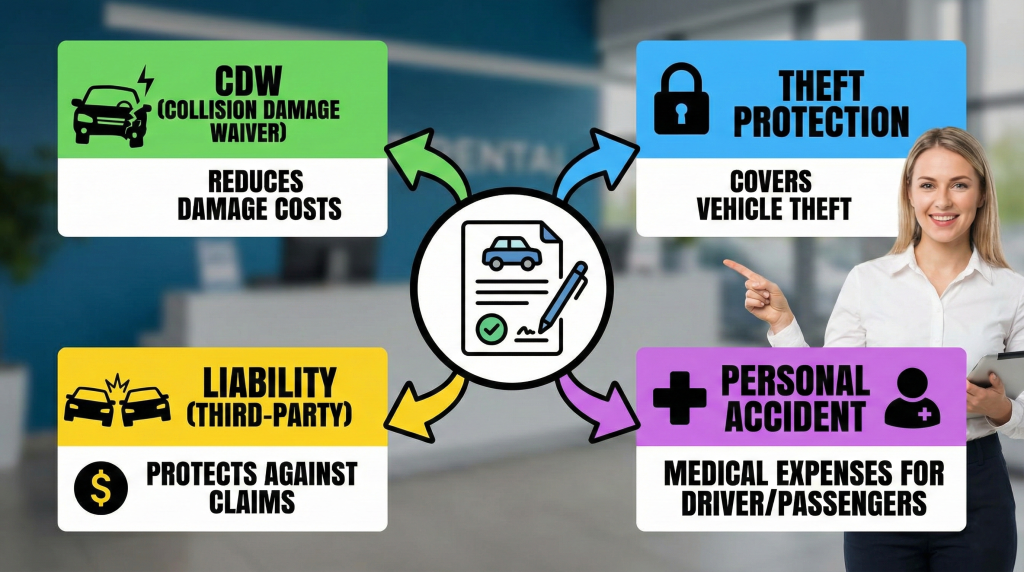
Credit cards often provide CDW automatically, but coverage varies by card issuer and sometimes by country. American Express typically covers CDW globally, while some Visa and Mastercard products exclude certain countries or vehicle types. Understanding your existing coverage before booking prevents paying twice for the same protection, but verification requires reading card benefits carefully—general customer service representatives often provide incomplete or incorrect information about rental car coverage specifics.
Third-party insurance providers like InsureMyRentalCar or RentalCover offer comprehensive coverage for $8-15 daily, significantly below the $25-45 that rental companies charge at the desk. These policies work on a reimbursement basis: you accept the rental company’s liability, pay any damage claims, then file for reimbursement from the third-party insurer. This creates short-term cash flow exposure but often saves $150-300 on a week-long rental.
Optional add-ons follow a consistent markup pattern across providers. GPS units rent for $10-15 daily despite costing rental companies $80-120 to purchase. Child seats command similar daily rates. Additional driver fees range from $10-15 daily even though the administrative cost to the company is effectively zero. These fees aren’t negotiable, though some loyalty programs or corporate accounts waive them.
Post-rental dispute costs represent the least visible but potentially most expensive category. When a rental company claims damage you didn’t cause, you enter a dispute process that varies dramatically by provider. Companies with good reputations investigate claims fairly and reverse unjustified charges within 2-3 weeks. Poor performers make reversal extremely difficult, often requiring formal complaints, credit card disputes, or legal intervention. The financial exposure isn’t just the damage claim—it’s your time, the risk of credit card interest if you dispute charges, and the reality that some companies deliberately make resolution difficult enough that many travelers simply pay.
In Short: Total rental costs combine base rates, mandatory fees, insurance, optional add-ons, and potential dispute costs. Understanding each category—and how different companies structure these charges—matters more than comparing base rates alone. The best car rental company 2026 isn’t necessarily the cheapest advertised option, but rather the one whose total cost structure and dispute resolution process creates the lowest risk-adjusted expense.
Company-by-Company Performance Analysis
Rental company performance data comes from multiple sources: consumer surveys capturing 2,000+ experiences annually, regulatory complaints filed with European consumer protection agencies, Better Business Bureau records in the US, and chargeback dispute patterns tracked by payment processors. These data sources reveal consistent patterns across providers.
AutoReisen and Cicar dominate satisfaction rankings with customer scores above 90%. Both operate primarily in the Canary Islands, with Cicar also present on mainland Spain under different terms and conditions. Their all-inclusive pricing model eliminates insurance upselling by making comprehensive coverage mandatory. Base rates appear higher—$35-45 daily when competitors advertise $20-25—but final costs typically land 15-25% below alternatives once insurance and fees are factored in.
The operational difference is structural. AutoReisen and Cicar don’t employ commission-based desk agents because there’s nothing to upsell. Vehicle condition ratings for both companies consistently exceed 4.5/5.0, indicating fleet quality matches or exceeds larger competitors despite smaller scale. Damage documentation at pickup is thorough, reducing post-rental disputes. Both companies have damage claim reversal rates above 75% when travelers contest charges, suggesting fairer claim practices than industry average.
The limitation is geographic. Unless you’re traveling to the Canaries or specific mainland Spain locations, these providers aren’t options. This geographic constraint is why they’ve maintained quality standards—they’re not pursuing rapid expansion that often degrades service as companies scale.
Enterprise, Alamo, and Hertz occupy the middle tier with customer satisfaction around 71-73%. These multinational providers offer consistent global coverage, making them practical choices for travelers who need rental cars across multiple countries or prefer working with a familiar brand. Fleet quality is generally high—vehicles average 15,000-35,000 miles with recent model years. Damage documentation processes vary by location but are reasonably thorough at major airport facilities.
The insurance model is optional-upsell: companies offer coverage during online booking at below-desk rates (typically $15-20 daily for comprehensive protection), but also train desk agents to sell the same coverage at $30-40 daily to travelers who decline online. This creates a transparency problem—the coverage is available affordably, but only if you know to buy it during booking rather than at pickup.
Damage claim practices at these providers generate mixed feedback. Major facilities in the US and Western Europe tend to handle disputes fairly, with investigation processes and reasonable reversal rates. Smaller locations in Southern Europe, Latin America, and other markets show higher complaint volumes around damage claims that travelers dispute. The inconsistency suggests franchisee or location-level variation rather than company-wide policy, but the result is identical for affected travelers—contested charges that require weeks or months to resolve.
Value positioning for these mid-tier companies depends heavily on booking approach. Travelers who secure online insurance, document vehicle condition carefully at pickup, and decline desk upsells typically experience acceptable service at competitive total costs. Those who arrive unprepared for insurance decisions or miss damage documentation often face significantly worse outcomes.
Europcar sits slightly below the mid-tier at 69% satisfaction. The company underwent ownership changes and fleet reduction in recent years, creating service inconsistency across locations. Some facilities maintain good standards while others show deterioration in vehicle condition and customer service responsiveness. Insurance practices mirror other mid-tier providers—optional during booking, aggressively sold at the desk—but complaint patterns suggest higher damage claim dispute rates than Enterprise or Hertz.
The company’s value proposition has weakened as base rates have increased to match competitors while service quality has declined in many markets. Unless Europcar offers meaningfully lower pricing (15%+ below alternatives) or you’re using corporate accounts with negotiated rates, travelers typically get better risk-adjusted value from Enterprise, Alamo, or Hertz.
Goldcar consistently ranks at the bottom of independent satisfaction surveys with scores in the low 50s to high 40s. The business model relies on low advertised rates that exclude virtually all coverage and protection. Desk conversion tactics are aggressive, with staff trained to present insurance as mandatory or imply that declining coverage means accepting unlimited liability. These practices have drawn regulatory action in Spain and Portugal.
Vehicle condition ratings for Goldcar are acceptable—around 3.8/5.0—but the company shows elevated damage claim rates compared to peer providers. Travelers report unclear damage documentation at pickup and frequent surprise charges for damage they dispute. The dispute resolution process is notably difficult, with many travelers reporting that contesting charges requires formal complaints, credit card disputes, or legal intervention.
The financial math rarely works in Goldcar’s favor. A $20/day advertised rate becomes $45-55/day once insurance, additional driver fees, and mandatory charges apply—matching or exceeding alternatives that offer better vehicles, clearer processes, and fairer dispute resolution. The only scenario where Goldcar delivers value is when travelers already hold comprehensive third-party insurance, carefully document vehicle condition themselves, and accept the elevated dispute risk.
Key Takeaways: Company performance varies significantly in ways that price comparison alone doesn’t capture. All-inclusive providers like AutoReisen and Cicar eliminate complexity but serve limited geographic markets. Mid-tier multinationals offer consistency and global coverage but require careful navigation of optional insurance and add-on fees. Budget providers depend on desk conversion tactics that create poor experiences and rarely deliver promised savings.
Regional Variations That Matter
Rental company performance isn’t uniform across markets. The same provider might deliver excellent service in Barcelona but problematic experiences in Faro, Portugal. These regional variations stem from regulatory enforcement, franchisee quality, competitive dynamics, and local market practices.
Southern European markets—Spain, Portugal, Italy, and Greece—show the highest concentration of aggressive insurance selling and damage claim disputes. Multiple factors drive this pattern. Tourism volumes create transient customer bases less likely to pursue extended disputes. Regulatory enforcement is inconsistent despite EU consumer protection rules. Seasonal demand allows companies to maintain practices that would drive customers away in more competitive markets.
Spain has seen particular regulatory attention. Consumer affairs authorities issued formal warnings to multiple rental companies in 2024 about insurance sales tactics, damage claim practices, and pricing transparency. Some improvement has occurred, but complaint volumes remain elevated compared to Northern European markets. Travelers renting in Spain should expect insurance upselling, carefully document vehicle condition at both pickup and return, and strongly consider third-party insurance purchased before arrival.
Portugal follows similar patterns. The Algarve region, popular with British tourists, generates particularly high rental car complaint volumes. Faro airport has become notorious for aggressive desk tactics and questionable damage claims. The good news is that awareness of these issues has grown—travelers who prepare accordingly typically avoid problems.
Greece shows improvement since 2022. Rental companies in Crete and Rhodes historically had poor reputations, but increased competition from higher-quality local providers and regulatory pressure have driven some positive change. Problems still exist, particularly at smaller rental desks in island airports, but major facilities in Athens and Thessaloniki now operate with clearer processes.
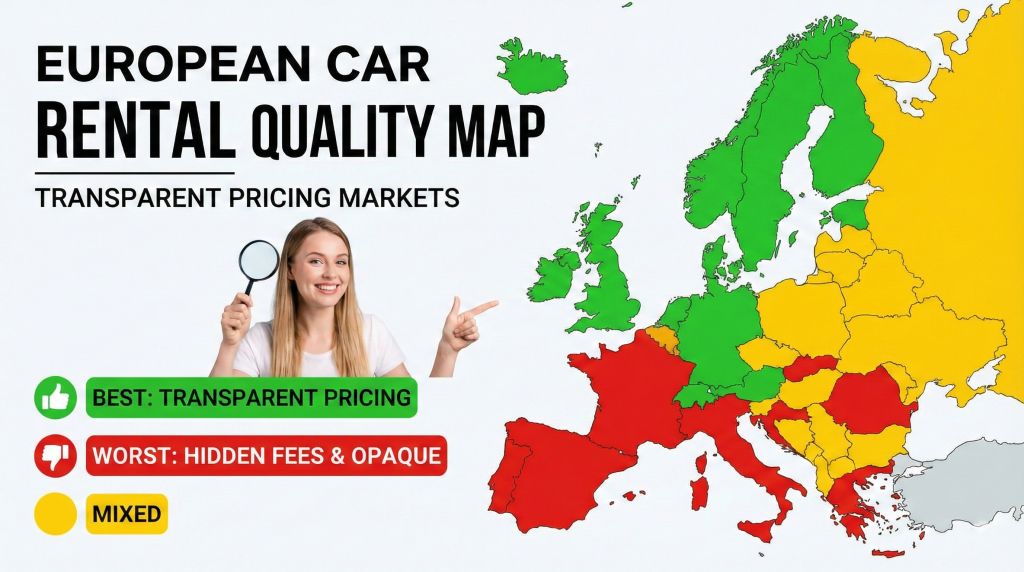
United States rental markets operate differently. Federal Trade Commission oversight and state consumer protection laws create better transparency requirements and dispute resolution processes. Desk upselling still occurs, but refund processing and damage claim investigations generally work more fairly than in Southern Europe. The challenge in US markets is price—rates have increased substantially since 2020, with popular destinations like Florida, Hawaii, and Arizona seeing 40-50% increases during peak seasons.
UK rentals are generally straightforward. Domestic competition is high, regulatory oversight is strong, and rental companies depend more on repeat business than transient tourism. Enterprise and Hertz dominate the market with consistent quality. Insurance upselling is less aggressive than Continental Europe. The main cost consideration is whether you need coverage for travel outside England, Scotland, and Wales—many rental agreements restrict or exclude Northern Ireland and Ireland, requiring separate insurance or rental arrangements.
Canary Islands represent the best rental environment globally, largely because AutoReisen and Cicar force competitive improvement. These islands are Spanish territory but operate as a distinct rental market due to tax differences and tourism patterns. All-inclusive pricing is more common, damage documentation is more thorough, and complaint rates are significantly below mainland Spain or other Mediterranean destinations.
Latin America and Asia-Pacific markets require more careful provider selection. Major international brands maintain acceptable standards in primary cities—Mexico City, São Paulo, Bangkok, Singapore—but quality deteriorates rapidly outside major metropolitan areas. Third-party insurance is essentially mandatory for these markets since dispute resolution across borders becomes extremely difficult if problems arise.
Insurance, Damage Claims, and Hidden Fees
The insurance decision represents the single largest variable cost in car rentals and the primary profit driver for most rental companies. Understanding what coverage you actually need, what you already have, and how to buy it most efficiently saves substantial money without increasing risk.
Collision damage waiver is the baseline coverage most travelers need. CDW eliminates your liability for damage to the rental vehicle itself. Without CDW, you’re responsible for repair costs up to the vehicle’s full value—$20,000-40,000 for most rental cars. Credit card coverage typically provides CDW automatically, but verification is essential because coverage varies by issuer, card tier, and sometimes destination country.
American Express Platinum, Chase Sapphire Reserve, and several other premium cards offer primary CDW coverage, meaning the card company pays claims directly without involving your personal auto insurance. Most non-premium cards offer secondary coverage, which pays only after your personal auto insurance processes the claim. This distinction matters because involving your personal insurance can affect rates even if the credit card ultimately reimburses costs.
Coverage verification requires contacting your card’s benefits department—not general customer service—and asking specifically about rental car coverage in your destination country. Some cards exclude coverage in Ireland, Israel, Jamaica, and a few other countries. Others exclude certain vehicle types (luxury cars, vans, trucks) or rental periods beyond 15-31 days. Getting written confirmation of coverage before travel prevents surprises if a claim occurs.
Third-party insurance from specialists like InsureMyRentalCar or RentalCover provides an alternative to both credit card and rental company coverage. These policies typically cost $8-12 daily for comprehensive protection including CDW, theft, liability, and personal accident coverage. The reimbursement model means you’re temporarily liable and must pay any damage claims to the rental company, then file with the insurer for reimbursement. Processing takes 2-4 weeks typically, creating short-term cash flow exposure but often saving $200+ on a week-long rental compared to rental company insurance rates.
The reimbursement approach does introduce friction. Some rental companies attempt to process damage charges immediately to your credit card rather than waiting for your departure, accelerating the cash flow impact. You’ll need to file a claim with supporting documentation—rental agreement, damage photos, correspondence with the rental company—and wait for the third-party insurer to investigate and pay. The process works well when damage is clear-cut, but becomes more complicated if the rental company disputes damage facts or claims amounts exceed reasonable repair costs.
Damage documentation at pickup is non-negotiable regardless of insurance approach. The walk-around inspection that happens when you pick up the vehicle determines what pre-existing damage is noted. Taking your own photos of all four sides, the roof, undercarriage (if visible), wheels, and interior before leaving the lot creates evidence if disputes arise. This takes 3-5 minutes but prevents the majority of questionable damage claims.
Pay particular attention to areas rental agents often miss or minimize during inspection: wheel scratches, minor door dings, small windshield chips, interior stains or wear, and underbody scuffs. These items individually seem trivial but can become $200-500 charges if not documented at pickup.
Return inspection follows the same principle. Don’t simply drop keys and leave. Wait for an agent to inspect the vehicle and provide a written confirmation of no damage. If immediate inspection isn’t available, take your own comprehensive photos timestamped at return. This evidence becomes essential if damage claims arrive weeks later.
Hidden fees typically fall into four categories: mandatory location surcharges, young driver fees, one-way rental charges, and fuel policy penalties.
Location surcharges apply primarily at airports and train stations where rental companies pay facility fees to the transportation authority. These fees range from 8-15% of base rental costs and are largely unavoidable—off-airport locations sometimes offer lower rates, but the savings often disappear once you factor in the cost and inconvenience of reaching them.
Young driver fees apply to renters under 25, with some companies restricting rentals entirely to drivers 21 or older. The surcharge typically adds $15-25 daily, significantly increasing costs for younger travelers. These fees aren’t negotiable at the rental counter but some companies waive them for loyalty program members or corporate account bookings.
One-way rental charges apply when you pick up a vehicle in one city and return it to another. Costs vary enormously based on distance and demand patterns. A Florence-to-Rome one-way rental might add $50-100, while smaller cities or opposite-direction routes can trigger charges of $300-800. These fees reflect the rental company’s cost of repositioning vehicles but often exceed actual repositioning expenses by significant margins.
Fuel policies create the final common fee category. Most rentals operate on a full-to-full basis—you receive the car with a full tank and return it full. Failure to refuel triggers refueling charges that dramatically exceed local gas station prices, often $8-12 per gallon with additional administrative fees. Some rental companies offer prepaid fuel options where you purchase a full tank at pickup and return the car empty. These arrangements rarely deliver value because you’re buying a full tank at inflated prices and unlikely to return the vehicle completely empty.
What This Means: Insurance represents the primary cost variable and dispute driver in car rentals. Understanding what coverage you need, what you already have through credit cards or third-party policies, and how to document vehicle condition eliminates most financial risk while significantly reducing costs compared to buying insurance at the rental desk.
When to Use Rental Brokers vs Direct Booking
Rental brokers aggregate inventory from multiple rental companies and handle the booking, payment, and often customer service for your rental. Direct booking means working with the rental company itself through their website or phone reservations. Each approach has distinct advantages depending on your situation.
Brokers like Zest Car Rental, Auto Europe, and CarRentals.com create value through volume relationships with local rental providers and by vetting quality before adding companies to their platforms. Zest, for example, explicitly refuses to work with Goldcar due to consistent quality problems. This curation matters because it eliminates the worst-performing companies from your comparison entirely.
The broker model also provides a single point of contact if problems arise. Rather than navigating language barriers and international phone trees with a rental company in another country, you work with broker customer service in your own language. This advantage is most valuable when disputes occur—damage claims, insurance confusion, or booking errors become significantly easier to resolve when a broker representative handles communication with the underlying rental provider.
Pricing through quality brokers is typically competitive with or slightly below direct booking rates because brokers secure volume discounts. You’re not paying a premium for the broker’s service—they’re compensated by the rental company rather than adding markup to your cost. The exception occurs during promotions or loyalty discounts that rental companies offer for direct bookings but don’t extend to broker channels.
Insurance through brokers follows the same optional model as mid-tier rental companies. The broker offers coverage during booking, typically from the same insurers the rental company would use. Pricing is usually equivalent whether you buy through the broker or directly from the rental company. The difference is that brokers can explain options more clearly and help you understand whether coverage makes sense given your existing protection from credit cards or third-party policies.
The case for direct booking strengthens when you have loyalty status with a rental company that waives fees or provides free upgrades. Enterprise Plus, Hertz Gold Plus Rewards, and similar programs offer meaningful benefits including expedited pickup, complimentary additional drivers, and sometimes upgrade availability. These perks don’t transfer through broker bookings.
Corporate accounts represent another direct booking advantage. If your employer has negotiated rates or insurance waivers with specific rental providers, you’ll typically need to book directly to access these terms. Corporate bookings also simplify expense reporting since the transaction is directly with the rental company rather than through a broker intermediary.
Flexibility and cancellation policies sometimes differ between direct and broker bookings. Rental companies generally offer free cancellation until 24-48 hours before pickup when booking directly. Brokers may match these terms or may have slightly more restrictive policies depending on their agreements with underlying providers. Reading cancellation terms before booking matters when travel plans might change.
The reliability question—whether rental companies honor broker bookings as readily as direct reservations—occasionally surfaces in traveler discussions. In practice, confirmed reservations from established brokers are honored identically to direct bookings. The rental company receives payment from the broker and processes your rental normally. Issues arise primarily when reservation details don’t match—name misspellings, incorrect pickup times, or payment authorization problems—but these occur with equal frequency in direct bookings.
Bottom Line: Brokers deliver the most value when you lack rental company loyalty status, prefer simplified insurance decisions, or want a single point of contact for dispute resolution. Direct booking makes more sense when you have loyalty benefits to preserve, corporate account access, or know you’re selecting from high-quality providers where broker curation adds little value.
Conclusion
The best car rental company 2026 emerges from matching your specific trip context to provider strengths rather than defaulting to whatever appears cheapest in initial search results. All-inclusive options like AutoReisen and Cicar provide the clearest value proposition when available, eliminating insurance complexity and damage claim risk through upfront pricing transparency. Mid-tier multinationals like Enterprise, Alamo, and Hertz offer consistency and global coverage but require more active navigation of optional fees and insurance decisions.
Budget providers promising unusually low base rates almost never deliver better final costs than alternatives once insurance, fees, and dispute risk are factored in. The temptation to save $5-10 daily on advertised rates typically leads to spending $200+ more through desk upsells or damage claims.
Preparation determines outcomes more than company selection alone. Securing comprehensive insurance before arrival—either through credit card coverage verification or third-party policy purchase—eliminates the primary profit center that drives poor rental experiences. Documenting vehicle condition thoroughly at both pickup and return prevents the majority of disputed damage charges. Understanding what fees apply to your specific booking (airport charges, young driver surcharges, one-way costs) allows accurate cost comparison between options.
The rental car landscape has become more expensive and complex since 2020, but it hasn’t become more random. Companies with transparent pricing, fair dispute resolution, and consistent quality standards are identifiable through satisfaction data and regulatory records. Those providers cost more initially but deliver better risk-adjusted value. Budget options that depend on desk conversion tactics and damage claim revenue might advertise lower rates, but they rarely provide lower final costs and introduce uncertainty that makes budgeting difficult.
Your booking approach matters as much as company selection. Brokers provide valuable curation and support when you lack familiarity with local rental markets or want simplified dispute resolution. Direct booking preserves loyalty benefits and corporate account terms when those apply. The common thread is intentional decision-making based on your actual coverage needs, documentation discipline, and willingness to decline upsells rather than reactive choices made under pressure at the rental desk.