

Search Places to Stay & Save
Most travelers assume tour booking sites comparison shopping guarantees the lowest price. It doesn’t. Platforms compete on how well they hide what you’re actually paying for — and what happens when plans change. A “$50 food tour” on one site might cost $63 after fees, while the same tour booked directly costs $48. The platform that looks cheapest in search results often isn’t.
Tour booking sites have proliferated since 2020, each claiming to offer “best prices” or “verified reviews.” But pricing transparency, cancellation terms, and commission structures vary dramatically between platforms. Some operators list identical tours at different prices across multiple sites. Others quietly add service fees at checkout that weren’t visible during browsing. For travelers planning activities in unfamiliar destinations, proper tour booking sites comparison reveals which platform actually delivers value.
This guide examines how major tour booking platforms actually function, where their business models create friction for travelers, and which booking patterns consistently reduce total trip cost without sacrificing experience quality. No platform wins in every scenario. Your optimal choice depends on destination, activity type, group size, and how far in advance you’re booking.
Tour Booking Sites Comparison: What Actually Matters Beyond Search Results
Tour booking platforms fall into three business models, each with distinct trade-offs. Aggregator marketplaces like Viator and GetYourGuide list thousands of operators but add service fees and may show inflated base prices to offset their commission structure. Regional specialists like Klook (Asia-Pacific) or Civitatis (Europe/Latin America) often negotiate better rates with local operators but offer limited inventory outside their core markets. Direct booking engines embedded in operator websites eliminate middleman fees but lack the comparison shopping and consolidated reviews that aggregators provide.
The meaningful differences emerge after you click “book.” Aggregators typically charge 10-25% service fees on top of the activity price, though these fees appear at different stages depending on the platform. Some display fees upfront during search; others reveal them only at checkout. Regional specialists often absorb fees into the listed price, creating apparent savings that may not exist once you compare total costs across platforms. Direct bookings eliminate platform fees entirely but sacrifice the convenience of managing multiple activities through a single interface and the leverage that large platforms provide when disputing charges or requesting refunds.
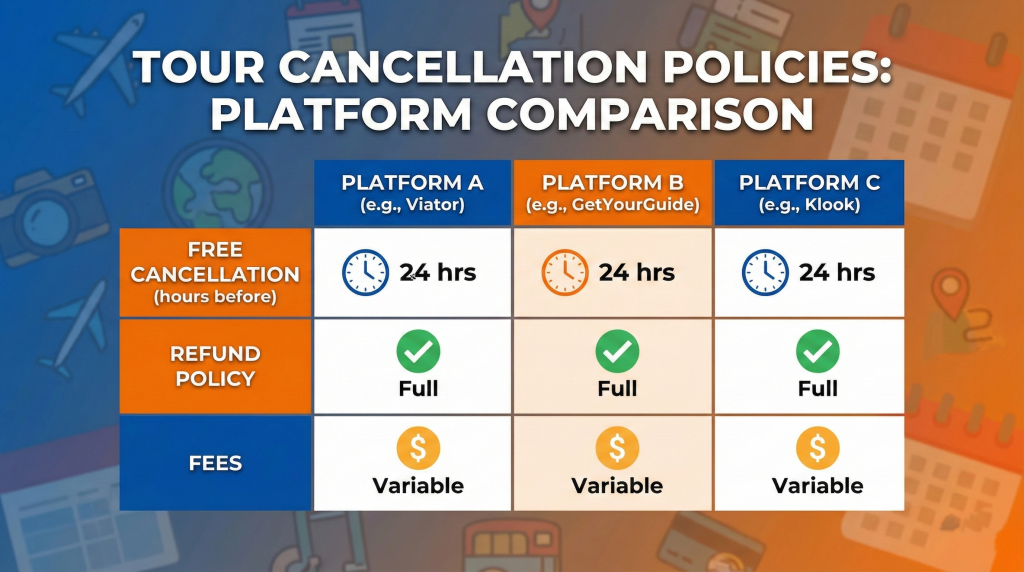
Platform choice also affects cancellation flexibility. Major aggregators standardize cancellation policies across operators — typically free cancellation up to 24-48 hours before the activity. This consistency simplifies planning but can override more generous policies that operators might offer through direct booking. Regional specialists vary widely; some match aggregator policies, while others impose stricter terms. Direct bookings follow operator-specific policies, which range from fully refundable to non-refundable depending on activity type and season.
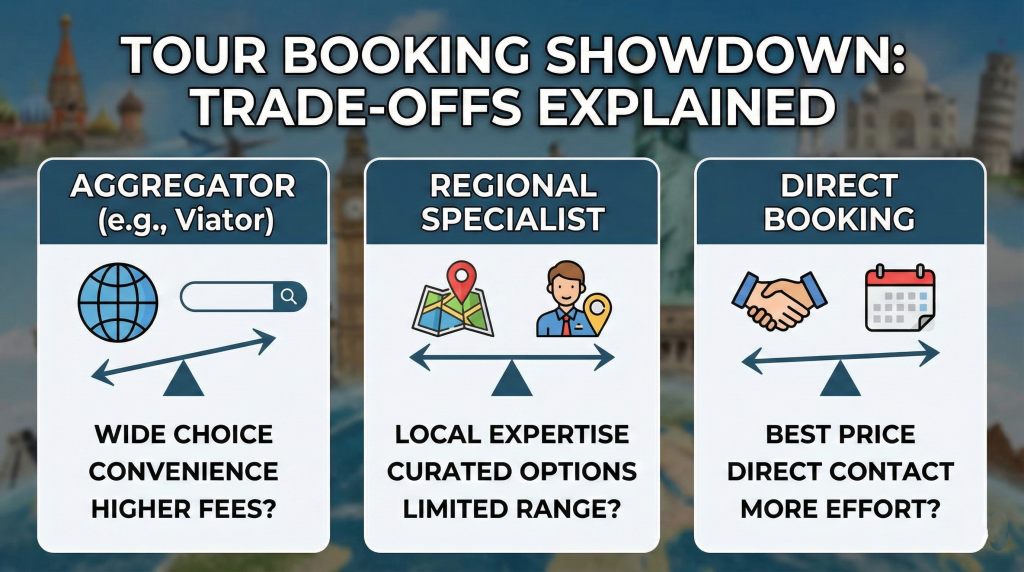
Quick Summary Aggregators add fees but provide comparison and review infrastructure. Regional specialists target specific markets with potentially better local rates. Direct booking eliminates middleman costs but requires separate transactions per operator. No platform type is universally superior; context determines the best fit.
The Real Cost of “Best Price” Promises: How Pricing Actually Works
Tour operators set wholesale prices, then platforms add markup. The listed price travelers see reflects both the operator’s base rate and the platform’s margin. This creates the common scenario where identical tours show different prices across platforms — not because one platform negotiated better rates, but because platforms structure their markups differently.
Viator, owned by TripAdvisor, typically displays the activity price and adds a separate booking fee at checkout. This fee ranges from 5-20% depending on activity cost, destination, and whether the booking qualifies for promotional pricing. GetYourGuide follows a similar model but often absorbs fees into the displayed price, creating the appearance of competitive pricing that may disappear when comparing final checkout totals. Klook’s pricing strategy varies by market; in Southeast Asia where it dominates, fees are often included in the listed price. In Europe or North America where it holds smaller market share, separate fees appear more frequently.
Price comparison becomes more complex with “lowest price guarantees.” These guarantees sound protective but contain restrictive terms that rarely trigger refunds. Most require that you find an identical tour (same operator, departure time, and included features) at a lower price on a competitor platform, then submit proof within 24 hours of booking. If approved — which happens infrequently — the refund equals the difference, not a broader credit. Travelers expecting meaningful price protection from these guarantees usually encounter frustration.
Dynamic pricing adds another layer. Some platforms adjust prices based on demand, booking velocity, or proximity to departure date. A walking tour listed at $40 on Monday might cost $48 on Thursday if booking volume increases. This isn’t manipulation; it mirrors airline pricing logic. But it means comparison shopping across multiple days can yield false conclusions about which platform offers consistently better rates.
Tour Booking Sites Comparison Analysis: Where Each Platform Actually Excels
Viator processes more tour bookings globally than any other platform, providing massive review volume and operator inventory. This breadth makes it ideal for popular destinations where activity choice matters more than marginal price differences. Service fees typically add 10-15% to the listed price, revealed at checkout. Cancellation terms are standardized at 24-hour free cancellation for most activities, with some same-day tours non-refundable. The mobile app functions reliably but shows intrusive upsell prompts during checkout. Travelers booking multi-day itineraries across several cities find value in consolidated booking management, though total fees across multiple activities can exceed $100 on a week-long trip.
GetYourGuide positions itself as premium-adjacent with emphasis on curated experiences and verified reviews. Pricing often includes fees in the displayed amount, simplifying comparison but obscuring the actual service charge. The platform excels in European city tours and museum skip-the-line access, where relationships with major cultural institutions create exclusive inventory. Cancellation flexibility matches Viator, though some premium experiences require 48-72 hour notice. The interface prioritizes visual storytelling over dense information, which appeals to travelers who value inspiration over clinical comparison. Booking patterns show GetYourGuide performs well for travelers planning signature experiences in well-trodden destinations but offers limited inventory in emerging markets.
Klook dominates Asia-Pacific tour booking with strong local operator relationships and aggressive regional pricing. Service fees are often absorbed into listed prices in Asian markets, creating genuine savings compared to Western-focused platforms. Cancellation policies vary more than competitors; budget activities frequently have no-refund terms while premium experiences allow 24-hour cancellation. The platform offers unique inventory like theme park tickets, airport transfers, and SIM cards — a broader travel services model that reduces the need to book through multiple sites. Travelers visiting Japan, Korea, Thailand, or Australia typically find Klook prices 10-25% lower than Viator for equivalent activities. Outside Asia-Pacific, inventory drops significantly and pricing advantages disappear.
Civitatis specializes in Spanish and Latin American destinations with strong local operator networks in Spain, Mexico, Argentina, and Colombia. The platform operates primarily in Spanish and English with less polished translation than competitors, but pricing consistently undercuts global aggregators by 15-30% in its core markets. Free cancellation typically extends to 24 hours, though some activities require longer notice. Travelers booking multi-day tours in Spanish-speaking countries or niche activities like tango lessons or cooking classes find Civitatis offers inventory that major platforms lack. Outside its geographic focus, the platform is irrelevant.
Direct operator booking eliminates platform fees entirely but requires more research and transaction management. Operators who maintain professional websites with secure payment processing often price tours 20-40% below aggregator listings, as they no longer pay 15-30% commission to platforms. The trade-off is loss of comparison convenience and centralized review infrastructure. Travelers comfortable researching operators, verifying legitimacy through independent reviews, and managing separate bookings per activity can achieve meaningful savings. This approach works best for signature experiences (private guides, multi-day tours, specialized activities) where the price difference exceeds $50-100 per person. For low-cost activities under $30, the time investment rarely justifies the savings.

Key Takeaways Viator offers broadest inventory but highest cumulative fees. GetYourGuide prioritizes premium European experiences with fees often embedded in pricing. Klook dominates Asian markets with genuine regional pricing advantages. Civitatis excels in Spanish-speaking destinations with significant discounts. Direct booking maximizes savings for high-value activities when you’re willing to research operators independently.
Hidden Fees and True Total Cost: What Platforms Don’t Highlight
Service fees represent only one layer of additional cost. Processing fees for credit card payments, typically 2-3%, appear on some platforms as separate line items. Resort fees or entrance fees not included in the tour price sometimes surface only in activity descriptions, requiring careful reading to identify. Gratuity guidance varies; some platforms suggest 15-20% tips for guides while others remain silent, leaving travelers uncertain about local norms.
Group bookings introduce per-person fee scaling where some platforms charge service fees per individual rather than per booking. A family of four booking a $40 activity might pay $6 in fees per person ($24 total) rather than $6 per booking. This multiplies platform costs significantly for groups, making direct booking or regional specialists more attractive.
Currency conversion markups add 2-4% on international bookings when platforms process payment in currencies different from your credit card’s home currency. This fee rarely appears explicitly; it’s embedded in the exchange rate. Travelers who don’t notice they’re being charged in USD instead of EUR or JPY lose this amount silently. Selecting local currency payment when offered and allowing your credit card issuer to handle conversion typically reduces this cost.
Booking insurance offered at checkout appears on most platforms with default opt-in selection, adding $5-15 per activity. This insurance rarely covers circumstances beyond platform control (weather, operator cancellation) and duplicates coverage many travelers already have through credit cards or travel insurance policies. Deselecting this option is almost always appropriate unless you lack any other cancellation coverage.
Cumulative fees across multiple bookings can exceed expectations. A couple booking six activities over a week-long trip might pay $280 in tour costs plus $45 in service fees, $15 in processing fees, and $30 in insurance they didn’t realize they selected — a 32% increase from listed prices to final cost. Reviewing itemized charges before confirming payment and comparing these totals across platforms yields clearer cost pictures than evaluating listed prices alone.
When Direct Booking Beats Aggregators: The Mathematical Threshold
Direct operator booking makes financial sense when the price difference exceeds the value you place on platform conveniences. For a $150 per-person activity where the operator’s website lists the same tour at $120 (saving $30), you’re paying $30 for aggregator review access, cancellation standardization, and payment protection. Whether that’s worthwhile depends on operator reputation, activity complexity, and risk tolerance.
The formula becomes clearer with high-value, multi-person bookings. A private day tour for four people listed at $600 on Viator might cost $450 direct from the operator — a $150 savings. That savings likely justifies the extra research required to verify operator legitimacy and arrange direct payment. For a $25 walking tour where direct booking saves $5, the convenience of aggregator booking usually wins.
Operator verification becomes critical with direct booking. Reliable indicators include professional website with secure payment processing, presence on Google Maps with substantial recent reviews, business registration information publicly visible, and responsive communication. Red flags include payment requests via personal PayPal or wire transfer, no physical business address, generic email domains, and pressure to book immediately without time to research.
Payment security differs between platforms and direct bookings. Major aggregators provide buyer protection through credit card processing infrastructure and dispute resolution systems. Direct bookings offer the same credit card protection but lack platform mediation. For activities under $100, this distinction rarely matters. For premium tours exceeding $500, using a credit card with strong fraud protection becomes more important when booking directly.
Some operators offer direct booking incentives beyond price matching, including room for itinerary customization, flexibility on group size limits, or willingness to adjust start times. These soft benefits appeal to travelers with specific needs that standardized platform listings can’t accommodate. An operator might refuse to adjust a tour for one person booking through Viator but agree to modifications when that person books directly and builds rapport.
Mobile Experience and Last-Minute Bookings: Where Platforms Diverge Under Pressure
Mobile booking now accounts for 60-70% of tour reservations, making app quality and mobile web performance increasingly important. Travelers standing outside a museum deciding whether to book a tour, or looking for dinner activities after hotel check-in, need platforms that load quickly and process payments smoothly on cellular connections.
Viator’s mobile app handles search and booking competently but pushes aggressive upsells and “complete your experience” prompts that slow navigation. The saved payment information feature works reliably across devices, reducing friction for travelers making multiple bookings. Download and offline access to booking confirmations prevents last-minute access issues when connectivity drops.
GetYourGuide’s app emphasizes visual discovery over search efficiency, making it better suited for browsing than targeted activity lookup. The map view showing nearby activities helps last-minute planners but loads slowly on weak connections. Booking confirmation emails include detailed meeting point instructions and local contact numbers, reducing anxiety around logistics.
Klook’s app processes same-day bookings faster than Western competitors, reflecting Asia-Pacific market norms where last-minute activity booking is common. The instant confirmation feature for select activities provides QR code tickets within seconds, eliminating will-call anxiety. However, English-language customer support response times lag during Asian business hours, creating challenges for travelers in European or American time zones needing urgent assistance.
Mobile web experiences vary more than apps. Viator’s mobile site mirrors app functionality with slightly slower loading. GetYourGuide’s mobile web interface compresses images aggressively, reducing visual appeal but maintaining speed. Klook’s mobile site underperforms its app significantly, making the app essential for travelers using the platform in Asia.
Same-day booking availability differs across platforms and depends on operator policies more than platform functionality. Most tours allow instant booking up to departure time if spots remain available. Some operators impose cutoff times (bookings close 2-4 hours before departure) regardless of availability. This information appears inconsistently in listings; travelers making last-minute plans should verify cutoff times before assuming same-day availability.
In Short Viator’s mobile app handles repeat bookings efficiently but includes friction from upsell prompts. GetYourGuide prioritizes visuals over speed, better for browsing than targeted search. Klook excels at last-minute Asian bookings with instant confirmation. Mobile web performance varies significantly; downloading apps before trips reduces friction.
Cancellation Policies: Where Platforms Actually Differ When Plans Change
Standardized “free cancellation up to 24 hours” policies dominate major platforms, but implementation details create meaningful differences. Refund processing speed varies from 3-5 business days (Viator, GetYourGuide) to 7-14 days (smaller platforms). Partial refunds for cancellations made within the penalty window (0-24 hours before departure) range from 0% to 50% depending on operator and platform policy.
Weather cancellations trigger different responses. Most platforms defer to operator judgment on whether conditions warrant cancellation. If the operator proceeds with the tour, platforms typically don’t issue refunds even if travelers feel conditions are unsuitable. Some operators offer reschedule options rather than refunds; platforms facilitate this communication but don’t guarantee alternative dates. Travelers concerned about weather should verify refund eligibility for operator-initiated cancellations versus traveler-initiated cancellations.
No-show policies penalize travelers who book but don’t appear without canceling. Major platforms enforce full charges for no-shows, interpreting failure to cancel as acceptance of the reservation. This becomes relevant when travelers lose track of bookings, misread meeting times, or encounter transportation delays. Grace periods for late arrival vary by operator; most tours depart on schedule and don’t issue refunds for missed departures.
Medical or emergency cancellations rarely receive special treatment from platforms unless travel insurance is purchased at booking. Standard cancellation policies apply even when circumstances are sympathetic. Travelers with comprehensive travel insurance can often reclaim costs through their insurer, but platform-level relief is uncommon. This creates scenarios where sick travelers or those dealing with family emergencies lose 100% of activity costs despite circumstances outside their control.
Modification versus cancellation policies differ. Some platforms allow date or time changes without penalty up to 24 hours before departure, treating modifications separately from full cancellations. Others treat any change as a cancellation-and-rebook, triggering penalty fees. This distinction matters for travelers with tentative itineraries who may need schedule flexibility without wanting to cancel entirely.
Trust Signals: Reviews, Verification, and What They Mean
Review systems across platforms use different verification standards, creating inconsistent reliability. Verified purchase badges on Viator and GetYourGuide confirm reviewers actually booked through the platform, but don’t guarantee they completed the activity. Some reviews come from travelers who canceled or no-showed but still submitted ratings.
Review recency matters more than volume for assessing current operator quality. A tour with 500 reviews averaging 4.8 stars but nothing recent may indicate declining standards. A tour with 50 reviews averaging 4.6 stars but 20 reviews from the past two months provides a clearer current quality signal. Platforms sort reviews by various criteria (most helpful, most recent, highest rated), but default sorting often emphasizes older high-rated reviews over recent mixed feedback.
Response rates from operators indicate engagement and professionalism. Operators who respond to negative reviews with specific solutions or explanations demonstrate accountability. Operators who ignore criticism or respond defensively signal potential service issues. This pattern becomes visible after reading 10-15 reviews rather than focusing solely on star ratings.
Photo reviews provide ground truth that text descriptions can’t match. Travelers who post photos of actual tour experiences offer evidence of activity quality, group sizes, and location accuracy. Multiple photo reviews showing similar experiences increase confidence; discrepancies between listing photos and user photos suggest misleading marketing.
Platform verification of operators varies. GetYourGuide emphasizes “Verified Partner” badges for operators meeting operational and insurance standards. Viator provides less explicit verification but maintains operator performance monitoring that removes consistently poor performers. Klook’s verification standards are less transparent, particularly for smaller operators in emerging markets. This matters more for niche activities where operator legitimacy is harder to assess independently.
Conclusion: Matching Platform to Planning Style and Risk Tolerance
Tour booking platforms serve different traveler profiles, and optimal platform choice depends on factors beyond price. Convenience-focused travelers planning multi-city itineraries with numerous activities benefit from aggregator consolidation despite higher cumulative fees. The ability to manage all bookings, communications, and potential cancellations through a single interface reduces mental load and prevents logistical errors when managing complex trips.
Price-sensitive travelers willing to invest research time should compare direct operator pricing against platform listings for high-value activities. The 20-40% savings on premium tours often justify the additional booking steps, particularly for private guides, multi-day adventures, or specialized experiences where per-person costs exceed $150. For budget activities under $30, aggregator convenience typically outweighs minimal savings from direct booking.
Regional specialists make sense when destination aligns with platform strength. Travelers spending substantial time in Asia should prioritize Klook for local pricing advantages and instant confirmation features. Those focusing on Spanish-speaking countries benefit from Civitatis’s operator network and pricing structure. Neither platform offers meaningful advantages outside their core markets.
Risk management through platform selection depends on activity type and personal comfort with uncertainty. First-time international travelers or those booking unfamiliar activity types gain peace of mind from major platform standardization and buyer protection. Experienced travelers comfortable researching operators, reading independent reviews, and managing direct communication can bypass platform layers without meaningful risk increase.
The best tour booking strategy typically combines approaches: use aggregators for comparison research and smaller bookings where convenience matters, investigate direct booking for high-value activities where savings justify effort, and consider regional specialists when visiting their core markets. Total trip cost, activity variety, and time available for planning all influence the optimal mix. No single platform wins in every scenario, and travelers who remain flexible across booking methods consistently achieve better outcomes than those loyal to a single platform.