
Filing a flight delay compensation claim is simpler than most travelers realize, yet millions of eligible passengers never collect what they’re owed. If your flight arrived more than three hours late in the past six years and the airline caused the delay, you can file a flight delay compensation claim for up to £520 per person. The confusion isn’t accidental—airline systems create just enough friction that passengers give up. But the process doesn’t require legal expertise or claims companies taking 30% cuts. What it requires is understanding which delays qualify, how arrival time differs from departure time, and why the airline’s explanation matters more than most travelers think.
Understanding Eligibility Requirements
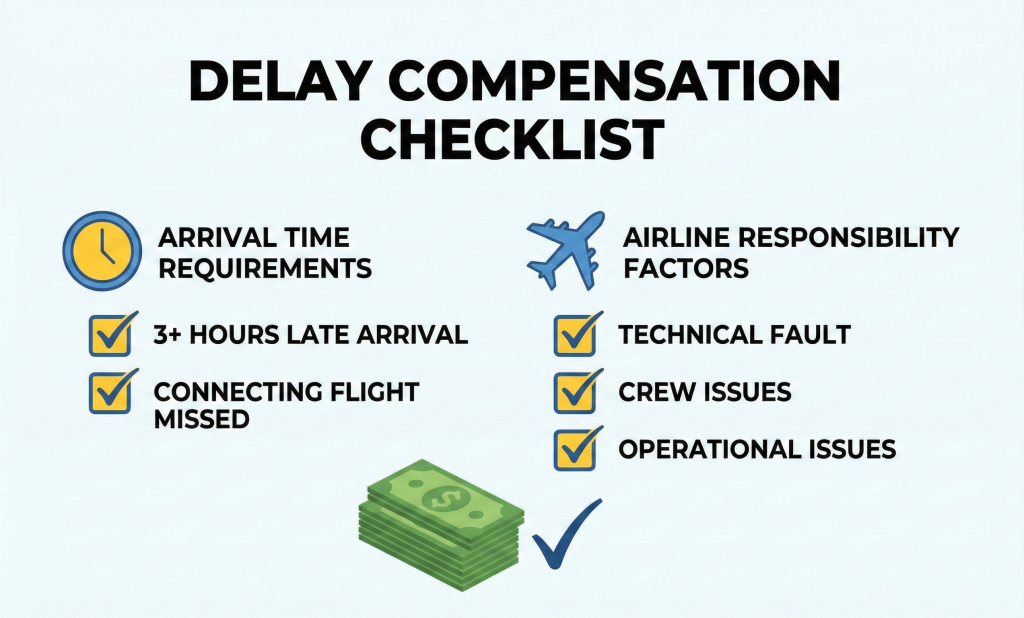
Flight delay compensation claim eligibility turns on four specific conditions, and missing any one of them disqualifies the entire claim. This matters because airlines often frame rejections around the least obvious rule rather than addressing the actual circumstances.
The delay must exceed three hours based on arrival time, not departure. Many travelers assume a four-hour departure delay guarantees compensation, but if the plane lands two hours and 55 minutes late, nothing is owed. Arrival time is measured when at least one aircraft door opens, not when the seatbelt sign turns off or when passengers reach the gate.
The flight must fall under UK or EU regulation. This covers any flight departing from a UK or EU airport, regardless of carrier, plus any UK or EU airline arriving into UK or EU airports from anywhere. A Manchester to New York flight qualifies on any airline. A New York to Manchester flight qualifies only if operated by a UK or EU carrier like British Airways—not if operated by American Airlines, even on a British Airways codeshare booking.
The delay must result from airline-controlled factors. Technical faults, crew shortages, and operational decisions qualify. Weather events, air traffic control strikes, and security threats don’t. The distinction matters because airlines routinely cite “extraordinary circumstances” for delays that actually stem from maintenance backlogs or crew scheduling failures.
The flight must have occurred within the past six years, or five years in Scotland. This lookback period catches many travelers off guard—compensation remains claimable years after the incident, yet most people assume the window closes within weeks.
In Short
Compensation hinges on arrival delay exceeding three hours, geographic coverage by UK/EU rules, airline responsibility for the cause, and filing within the statutory time limit. Departure delays don’t determine eligibility—only how late the plane lands matters.
Flight Coverage and Geographic Rules
The regulatory framework creates coverage gaps that become apparent only when examining specific routing scenarios. Understanding which authority governs a flight determines whether compensation rules apply at all.
UK and EU regulations mirror each other after Brexit, but they govern different flight sets. UK rules cover flights departing UK airports and UK carriers arriving into UK airports. EU rules cover flights departing EU airports and EU carriers arriving into EU airports. A London to Paris flight falls under both. A Dubai to London flight on Emirates falls under neither.
Codeshare arrangements introduce complications that booking platforms don’t clarify upfront. The operating carrier determines regulatory coverage, not the airline that sold the ticket. If you book through British Airways but return from New York on a codeshare operated by American Airlines, American’s operating control means UK/EU rules don’t apply—despite paying British Airways and receiving a British Airways ticket confirmation.
This creates a scenario where outbound and return legs of the same trip carry different compensation rights. Travelers often discover this gap only after a delay, when the airline explains that the return flight, though booked as a round trip, falls outside the regulatory framework.
Third-country carriers operating into UK/EU airports must comply with compensation rules for those specific inbound flights. Turkish Airlines flying Istanbul to London must follow UK rules for that London arrival, even though Turkey isn’t in the UK or EU. But the reverse—London to Istanbul—falls under UK rules because it departs a UK airport.
Compensation Amounts and Timing Rules
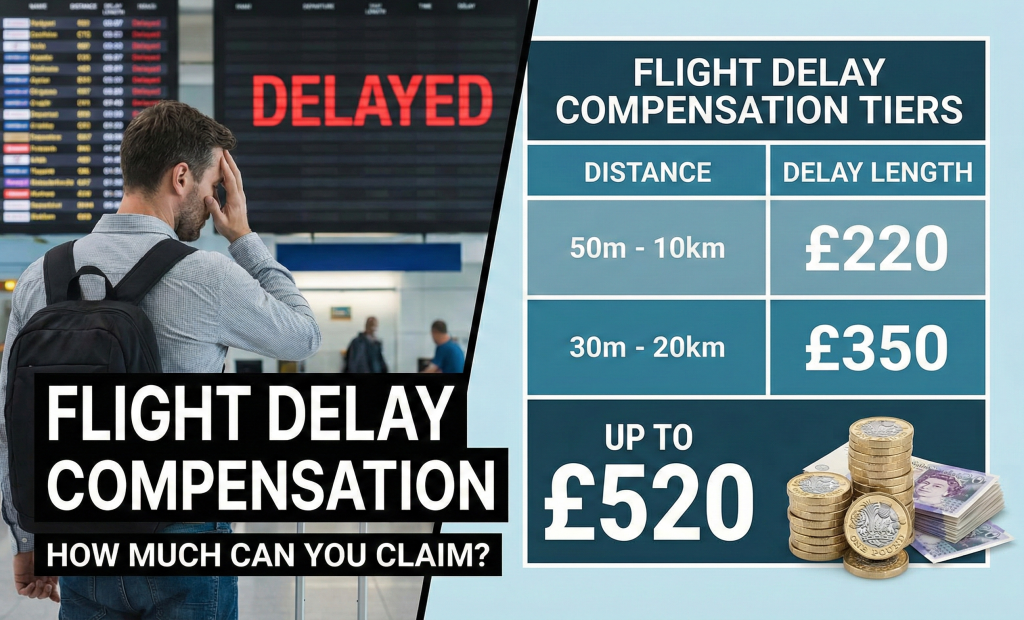
The compensation structure ignores ticket price and bases payouts entirely on distance and delay length. This creates situations where a £60 budget flight can generate £520 in compensation while a £600 premium ticket on a shorter route yields £220.
For flights up to 1,500 kilometers—roughly London to Paris or Manchester to Dublin—delays over three hours trigger £220 per passenger. Medium-range flights between 1,500 and 3,500 kilometers, like Manchester to Málaga, qualify for £350. Long-haul flights exceeding 3,500 kilometers operate on a split structure: three to four hour delays pay £260, while delays beyond four hours jump to £520.
The timing calculation often confuses travelers because it contradicts intuition. A five-hour departure delay that results in only a two-hour arrival delay earns nothing. Airlines can make up time in flight, and only the final arrival matters. This explains why airlines sometimes hold delayed flights at the gate—if they can limit the arrival delay to 2 hours 59 minutes, they avoid compensation obligations entirely.
The three-hour threshold creates a cliff effect where even one minute determines eligibility. A flight arriving two hours and 59 minutes late yields no compensation. At three hours exactly, £220 to £520 becomes immediately owed. Airlines understand this, which is why gate arrival times sometimes show manipulation in edge cases—there’s a strong financial incentive to document arrival at 2:59 rather than 3:01.
Distance measurement uses the great circle method between airports, not actual flight paths or connections. A London to Singapore flight with a layover in Dubai doesn’t calculate distance as London-Dubai-Singapore separately—it measures the direct London to Singapore distance, which exceeds 3,500 kilometers and qualifies for the higher compensation band.
Quick Summary
Compensation amounts depend on flight distance and delay length, not ticket cost. The structure creates larger payouts for longer delays on long-haul routes while shorter flights receive less regardless of ticket price. Arrival time determines everything, and delays under three hours trigger no compensation.
The Claims Process
Filing a flight delay compensation claim requires no legal representation, yet airlines benefit when passengers assume the process requires specialized help. The submission itself is straightforward, but knowing which information matters and how to frame the claim determines approval likelihood.
The initial claim goes directly to the operating airline, not the booking platform or travel agency. If you booked through Expedia but flew on Lufthansa metal, Lufthansa handles the claim. This matters because many travelers contact the wrong entity first, creating delays and confusion that sometimes discourage follow-through.
Claims must reference the specific regulation under which you’re seeking compensation. For EU-covered flights, cite EU Regulation 261/2004. For UK-covered flights post-Brexit, cite The Air Passenger Rights and Air Travel Organisers’ Licensing (Amendment) (EU Exit) Regulations 2019. These references signal that you understand the legal framework and aren’t making a general customer service complaint.
The claim should state exactly what happened, when arrival occurred, and what you’re requesting. Vague descriptions like “the flight was very delayed” weaken the claim compared to “Flight BA123 departed at 14:30, three hours late, and arrived at 18:45, four hours and 15 minutes late, qualifying for £520 compensation under EU Regulation 261/2004.”
Airlines typically respond within four to twelve weeks, though no legal deadline exists for initial responses. Some carriers acknowledge claims quickly but delay substantive responses, while others remain silent until escalation.
Documentation requirements are lighter than most travelers expect. The booking confirmation and boarding pass usually suffice. Flight tracking websites provide arrival time evidence if you didn’t personally document it. Airlines already have access to their own flight data, so providing extensive proof of delay isn’t necessary—they know when their planes landed.
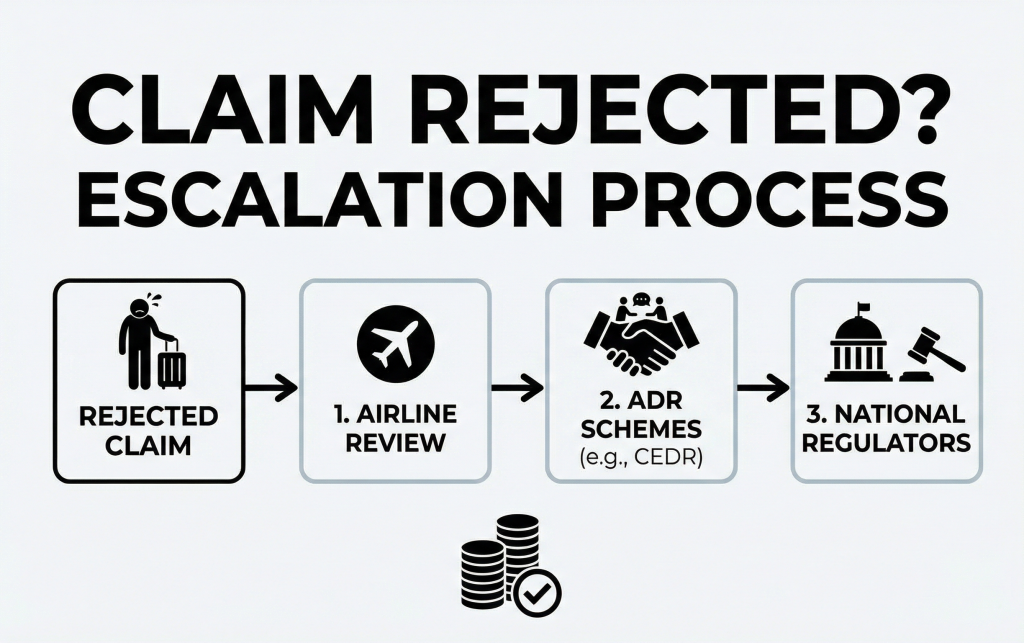
If the airline rejects the claim or doesn’t respond within eight weeks, escalation options depend on whether the carrier has joined an Alternative Dispute Resolution (ADR) scheme. Many major airlines now participate in ADR programs that issue binding decisions. If your airline uses an ADR scheme and your flight qualifies for that scheme’s coverage, you must escalate through that specific ADR—you can’t choose a different dispute resolution path.
Airlines without ADR membership require escalation to the Civil Aviation Authority for UK flights or the relevant EU member state regulator for EU flights. The CAA accepts online complaints at no charge, reviews eligibility within roughly one week, and issues final decisions within 10 weeks. However, CAA decisions aren’t binding—they provide an assessment and can pressure airlines, but can’t force payment the way ADR schemes can.
Some ADR schemes charge fees if your appeal fails. The CEDR scheme, which covers British Airways and Cathay Pacific, implements this cost structure. Before escalating to an ADR, verify whether it charges unsuccessful claimants.
Key Takeaways
The claims process starts with the operating airline, must cite the correct regulation, and should state specific delay details. Airlines respond within weeks to months, and rejected claims escalate either to binding ADR schemes or non-binding regulators depending on the carrier’s memberships.
When Airlines Reject Claims
Airlines reject valid claims more often than industry data suggests, and understanding the common rejection tactics helps travelers identify when to escalate rather than accept the decision.
The most frequent rejection cites “extraordinary circumstances” without providing specific evidence. Airlines might reference general weather in the region rather than demonstrating that weather directly caused that specific flight’s delay. If your flight delayed due to a technical issue discovered during routine checks, but the airline claims “operational disruptions beyond our control,” the rejection likely doesn’t hold up under scrutiny.
Crew illness recently became substantially easier to claim for after a landmark UK court ruling. Airlines previously used staff sickness as an automatic “extraordinary circumstances” defense. Courts determined that airline crew shortages—including those caused by illness—fall within the airline’s control because carriers must maintain adequate staff reserves. If an airline rejects your claim citing crew illness, this is now challengeable.
Some rejections claim the delay fell just under three hours when traveler records suggest otherwise. Airlines control the official arrival documentation, and gate times sometimes reflect flexibility in recording. If your own records—photos, flight tracking apps, or timestamped messages—show arrival times that contradict the airline’s claim, that documentation matters during escalation.
Another common rejection pattern involves airlines claiming the flight wasn’t covered by UK/EU regulations when the routing clearly was. This often happens with complex itineraries or codeshare flights where the airline hopes travelers won’t understand the coverage rules. A flight from Manchester to New York unquestionably falls under UK rules regardless of carrier, yet non-EU airlines sometimes reject these claims.
Airlines occasionally reject claims from passengers whose tickets were purchased by employers, stating that the company—not the passenger—is entitled to compensation. This isn’t correct. Compensation belongs to the passenger who experienced the delay, not the entity that paid for the ticket. If you traveled for work and your employer bought the ticket, any compensation owed is yours.
When rejections occur, the airline must explain whether it has joined an ADR scheme and, if so, which one. If the airline fails to provide this information, that’s itself a violation of the process and strengthens your escalation case with regulators.
Overbooking and Denied Boarding
Airlines intentionally sell more seats than exist on aircraft, banking on no-show rates to fill planes efficiently. When everyone shows up, somebody doesn’t get on—and compensation rules for denied boarding differ from delay compensation.
If the airline solicits volunteers to take a later flight, the compensation becomes negotiable between the passenger and carrier. This typically includes rebooking on the next available flight, possibly an upgrade, vouchers, and potentially cash. The amounts vary widely because there’s no regulatory floor when you volunteer.
Involuntary denied boarding—when the airline bumps you despite having a valid ticket and checking in properly—triggers mandatory compensation regardless of whether you accept the alternative flight or request a refund. This matters because delay compensation sometimes depends on accepting rebooking, but denied boarding compensation is owed even if you take the refund and make other arrangements.
The compensation amount for involuntary denied boarding depends on the alternative flight’s arrival time compared to your original booking. If the airline gets you there within two hours of the original arrival on short flights, or two to four hours on longer flights, reduced compensation applies. Longer delays trigger full compensation at the same rates as delay compensation: up to £520 depending on flight distance.
Airlines don’t randomly select passengers to deny boarding. Typical criteria include check-in time (later check-ins get bumped first), ticket type (deeply discounted fares face higher risk), and frequent flyer status (elite members rarely get denied). If you checked in late for a heavily booked flight on a budget ticket, denied boarding risk increases.
The denied boarding protections cover only overbooking scenarios, not operational issues. If the airline substitutes a smaller aircraft and everyone can’t fit, that’s operational, not overbooking, and denied boarding compensation may not apply—though delay compensation might if the rebooking arrives late enough.
What This Means
Voluntary denied boarding involves negotiated compensation with no regulatory minimums, while involuntary denied boarding triggers mandatory payments tied to how delayed the alternative flight arrives. The protections apply only to overbooking situations, not other operational reasons for using smaller aircraft.
Beyond UK/EU Flights
Travelers on routes outside UK/EU regulatory coverage don’t automatically lose all recourse, but the process becomes more fragmented and success rates drop substantially.
Most airlines base terms and conditions on International Air Transport Association (IATA) recommendations, which require offering delayed passengers a choice: later rebooking, alternative transport, or a refund. This creates a contractual obligation for rebooking or refunding, but it doesn’t mandate compensation for the delay itself the way UK/EU rules do.
Several countries beyond the UK and EU have implemented their own compensation schemes. Canada offers up to CAD $1,000 (approximately £585) for qualifying delays and cancellations. New Zealand provides compensation up to 10 times the ticket price. Turkey, Morocco, and India maintain systems similar to EU rules, with Morocco and Turkey using €600 equivalents (roughly £520) as maximums. Thailand’s system caps at 4,500 Baht (approximately £103).
The Montreal Convention covers international flights between signatory countries—more than 100 nations participate. This treaty allows claims for losses caused by delays, though it doesn’t mandate fixed compensation amounts like EU rules. Instead, you claim actual damages: hotel costs, replacement bookings, lost business opportunities. The burden of proof shifts to you to demonstrate and quantify losses, making Montreal Convention claims more complex than EU-style automatic compensation.
For flights to or from countries without specific compensation schemes—including the United States, Australia, Japan, and the United Arab Emirates—options narrow to contractual complaints based on the airline’s terms and possibly travel insurance coverage. The U.S. Department of Transportation maintains a dashboard showing what different airlines voluntarily offer for delays and cancellations, but these are airline policies, not regulated requirements.
Travel insurance provides another avenue for non-EU/UK flights, though coverage varies dramatically by policy. Some pay lump sums based on delay length—perhaps £50 for a three-hour delay, scaling upward. Others reimburse documented expenses like hotels or meals without paying for the delay inconvenience itself. Many budget travel insurance policies exclude delay coverage entirely or set minimum delay thresholds higher than three hours.
Bottom Line
Non-UK/EU flights may still offer compensation routes through national schemes in countries like Canada or New Zealand, Montreal Convention claims for actual damages, or travel insurance policies that cover delays. Success requires more documentation and effort than EU claims, and many routes offer no realistic compensation path at all.
Conclusion
Flight delay compensation exists because regulatory frameworks decided that airline operational failures shouldn’t fall entirely on passengers. The system isn’t automatic—airlines don’t proactively pay compensation—but it also isn’t as complicated as the industry silence around it suggests. Most travelers who arrive three or more hours late on UK or EU-covered flights have valid claims they never file, often because they assume the process requires expertise or expense it actually doesn’t.
The distinction between legitimate rejections and airline deflection matters. Weather delays and air traffic strikes don’t qualify. Technical failures and crew shortages do, especially after recent court rulings on staff illness. The arrival time rule—not departure delay—catches many travelers who assume they don’t qualify when they actually do.
For flights outside UK/EU coverage, the options become more scattered. Some countries maintain strong protections. Others offer only contractual obligations to rebook. The Montreal Convention provides a framework, but requires proving actual damages rather than triggering automatic fixed compensation. Travel insurance fills some gaps but varies too much to count on without checking the specific policy terms.
The core principle holds regardless of geography: when airlines cause delays, most regulatory systems create some form of recourse. Whether that recourse is accessible, fair, and sufficient varies dramatically by route. But on UK and EU flights, the framework works—if passengers know it exists and follow through with filing.