
Search Places to Stay & Save
The Evolution of Airline Fare Unbundling and Ancillary Revenue
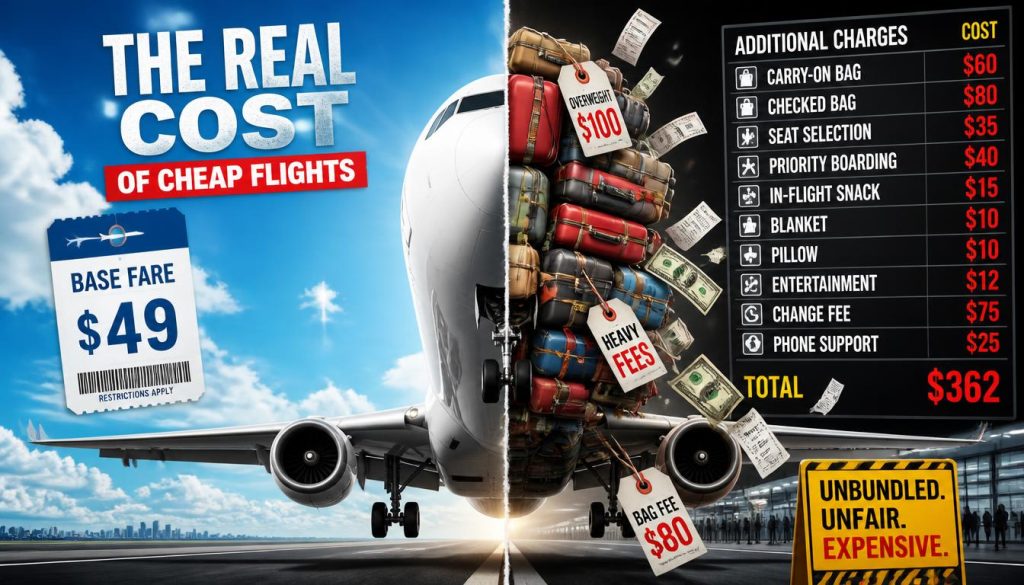
Modern commercial aviation operates on an unbundled pricing model, a systemic shift that has fundamentally transformed the economics of air travel over the last two decades. Historically, a standard airline ticket was an all-inclusive contract that covered passenger transport, meals, amenities, and a generous baggage allowance. However, following the economic volatility of the early 2000s and skyrocketing aviation fuel costs, commercial carriers sought new ways to stabilize pricing and boost profit margins. This led to the decoupling of physical seats from auxiliary services, turning baggage transport into a primary driver of ancillary revenue.
According to data tracked by the Bureau of Transportation Statistics, major commercial airlines generate billions of dollars annually solely from baggage levies. This revenue stream acts as a critical buffer against macroeconomic shifts, fuel price volatility, and fluctuating ticket demand. By stripping baggage allowances out of the base ticket price, carriers can advertise lower base fares on search engines and comparison platforms. This pricing strategy aligns with consumer behavior, as most travelers select flights based on the initial price shown, only encountering auxiliary costs later in the booking process. Consequently, understanding the underlying mechanics of airline baggage fees is no longer an optional skill; it is a core operational requirement for navigating contemporary transit networks.
Quick Summary
- Baggage fees are key drivers of airline profitability, acting as an economic stabilizer against fluctuating fuel prices.
- Unbundled pricing models allow airlines to advertise low base fares while charging separately for physical cargo weight.
- Baggage tracking systems and auxiliary fees are mathematically optimized to offset the logistical costs of ground handling.
The Physics of Flight: Weight, Balance, and Fuel Burn
The rules governing weight limits are rooted in physics and structural engineering. Every aircraft has a strictly defined Maximum Takeoff Weight (MTOW) and a precise Center of Gravity (CG) envelope within which it must operate to remain aerodynamically stable. Prior to departure, flight dispatchers must calculate the total weight of the passengers, cargo, fuel, and baggage to ensure the aircraft conforms to these safety parameters. An uneven distribution of weight can compromise aircraft controllability during takeoff and landing, requiring flight control surfaces to work harder, which increases aerodynamic drag and fuel consumption.
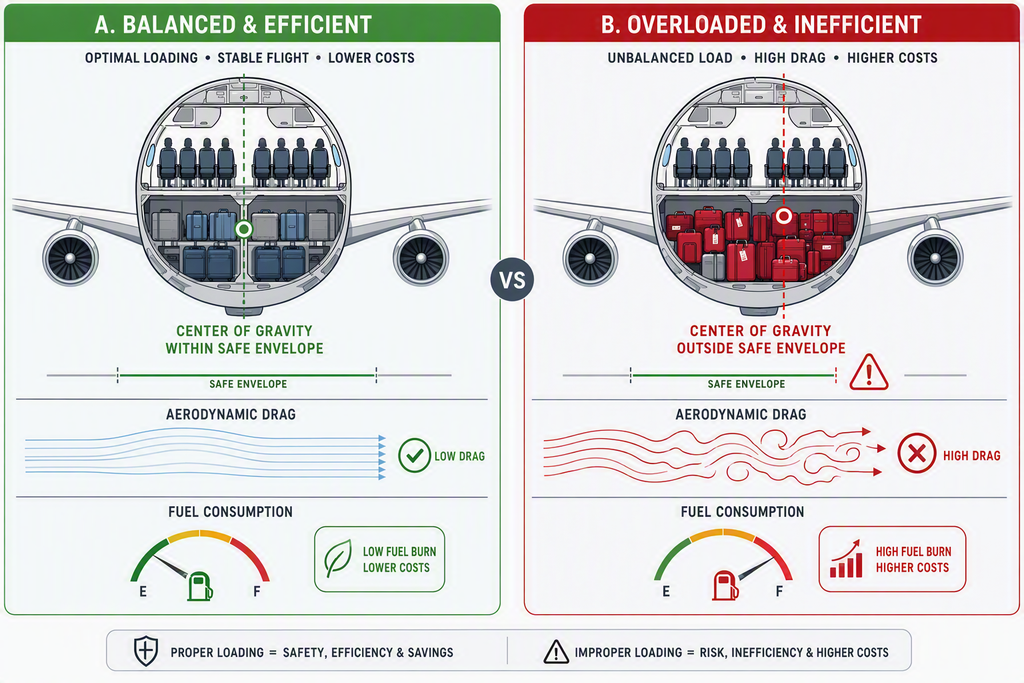
Every additional pound of cargo loaded onto an aircraft directly increases the fuel burn rate of the engines. When scaled across a global network operating thousands of daily flights, even minor weight deviations translate to massive fuel expenditures. The standard 50-pound (23-kilogram) weight limit for checked bags is a carefully calibrated threshold that balances aerodynamic efficiency with ground crew physical capabilities. The Occupational Safety and Health Administration outlines specific regulations regarding repetitive lifting of heavy objects to prevent musculoskeletal injuries among ramp agents and baggage handlers. When baggage exceeds this standard weight, it requires specialized handling, multiple personnel, or mechanical assistance, justifying the steep overweight penalties assessed by carriers.
Carrier Classification and Domestic Fee Structures
The domestic aviation market in the United States features a clear divide between legacy network carriers and ultra-low-cost carriers (ULCCs). Legacy carriers, such as Delta Air Lines, United Airlines, and American Airlines, maintain relatively standardized fee structures for domestic routes. These airlines typically allow passengers to carry one personal item and one standard overhead carry-on bag for free, while charging a fixed fee for checked luggage. These checked fees escalate progressively for the second and third bags, acting as a financial deterrent against excessive packing.
In contrast, ultra-low-cost carriers utilize a dynamic pricing structure where carry-on bags are frequently priced higher than checked bags. This seemingly counterintuitive model is designed to accelerate the boarding process. Cabin congestion caused by passengers struggling to find space for oversized carry-on bags is a primary cause of flight delays. By charging a premium for overhead bin space, ULCCs encourage passengers to check their luggage, reducing cabin boarding times and allowing the airline to maintain high aircraft utilization rates. Southwest Airlines remains the sole major exception in the domestic market, offering two checked bags free of charge as a core brand differentiator, offsetting these costs through optimized fleet utilization and standardized aircraft types.
Key Takeaways
- Legacy carriers offer free carry-on bags but charge standard fees for checked luggage, while budget carriers charge for both.
- Budget airlines price overhead carry-ons higher than checked bags to minimize cabin boarding delays and speed up gate turns.
- Southwest Airlines remains the only major domestic carrier offering a complimentary two-bag checked allowance.
| Carrier Type | Carry-On Allowance | First Checked Bag Fee | Weight Threshold |
|---|---|---|---|
| Legacy Carriers | Included (Personal + Cabin) | $35 – $40 | 50 lbs (23 kg) |
| Ultra-Low-Cost Carriers | Personal only (Cabin extra) | $40 – $65+ (Dynamic) | 40 lbs (18 kg) |
| Southwest Airlines | Included (Personal + Cabin) | $0 (First two free) | 50 lbs (23 kg) |
Basic Economy Restrictions and Contractual Realities
The introduction of Basic Economy ticket tiers has added significant complexity to baggage compliance. These restricted fares are designed to compete directly with budget airlines while maintaining legacy network connections. However, the terms of these tickets often restrict passengers to a single personal item that must fit entirely beneath the seat in front of them. Standard overhead carry-on bags are explicitly prohibited on several carriers for Basic Economy ticket holders on domestic routes.
If a passenger attempts to bring an unauthorized carry-on bag to the departure gate, the carrier will require the bag to be gate-checked. This triggers a double penalty: the standard checked bag fee plus an additional gate-handling surcharge. This fee is a behavioral deterrent designed to enforce compliance with boarding restrictions. The legal basis for these charges is detailed in the carrier’s Contract of Carriage, a legally binding document that passengers accept when purchasing a ticket. This contract gives airlines broad authority to establish luggage specifications, assess fees, and refuse service to passengers who do not follow boarding rules.
In Short
- Basic Economy tickets often restrict travelers to a single personal item that must fit beneath the seat.
- Bringing non-compliant luggage to the gate results in both standard check fees and high gate-handling surcharges.
- Baggage rules, dimensions, and penalty structures are legally defined in each airline’s Contract of Carriage.
Complex Routing: Interline Agreements and Codeshare Rules
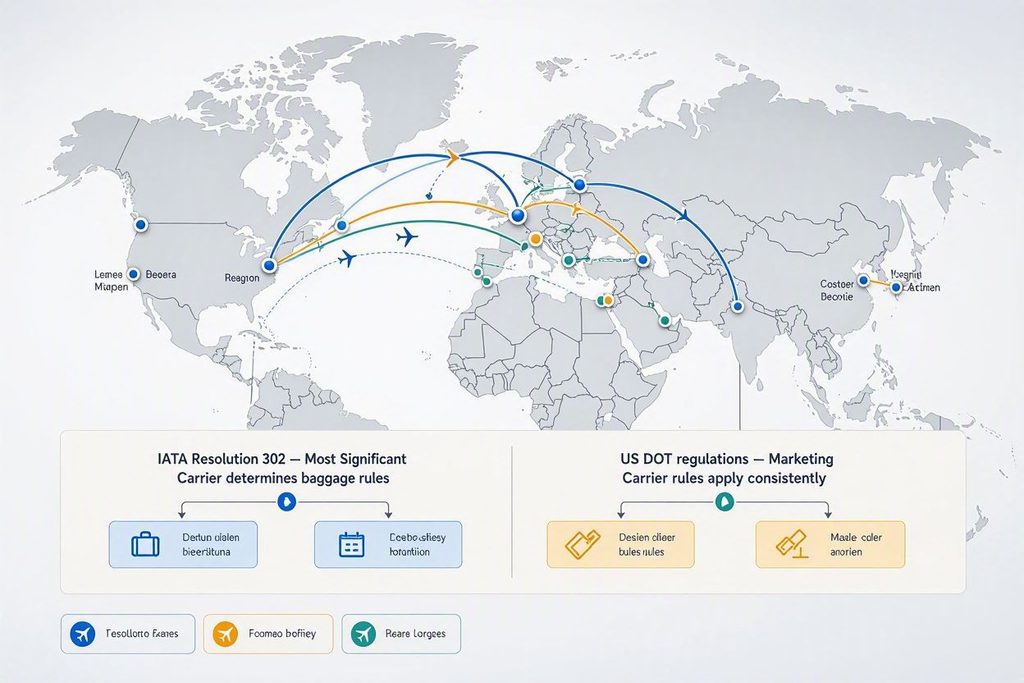
Multi-leg, codeshare, or interline itineraries involving more than one airline present significant challenges regarding baggage allowance calculations. When a passenger books a single journey that involves multiple carriers, determining which baggage rules apply requires a structured analysis. To resolve these conflicts, the International Air Transport Association Resolution 302 established a global framework. Under this resolution, the baggage rules of the Most Significant Carrier (MSC) typically govern the entire itinerary. The MSC is determined based on which carrier operates the first international flight or crossing of major geographical boundaries.
However, for itineraries originating or terminating at a United States port of entry, domestic laws supersede this standard. The Department of Transportation luggage guidelines mandate that for any flight sequence involving a US destination or origin, the baggage allowances, fees, and rules of the marketing carrier—the airline whose flight code is printed on the ticket—must apply consistently across all segments of the journey. This rule protects travelers from facing different baggage rules during connections. Additionally, if baggage is delayed, damaged, or lost during an interline transfer, the final operating carrier is legally responsible for handling the claim, regardless of which airline physically misplaced or damaged the items during transit.
International Travel and Global Treaty Protections
International and transoceanic routes operate under different baggage rules than domestic flights. While domestic flights rely heavily on individual piece-rate fees, standard international fares frequently include at least one checked bag, except on basic or light international fare tiers. Additionally, international luggage allowances are protected by international treaties that establish uniform standards for passenger rights and liability limits.
Under the Montreal Convention, air carriers are subject to strict liability for baggage damage, delay, or loss up to a specified maximum limit, which is valued in Special Drawing Rights (SDRs). This global treaty ensures that passengers receive standardized compensation for baggage issues, protecting them from arbitrary liability caps. However, travelers must remain aware that while transoceanic flights may permit a standard 50-pound limit, connecting regional flights within Europe, Asia, or Latin America often enforce much stricter weight limits, sometimes as low as 40 pounds (18 kilograms) or strict piece-count rules. This makes it essential to review the policies of all operating airlines on a complex international itinerary.
Bottom Line
- International baggage policies are governed by the Montreal Convention, establishing strict liability limits for damaged or delayed luggage.
- Transoceanic flights generally include a checked bag, but regional connecting flights abroad often enforce lower weight limits.
- For itineraries involving US airports, the marketing carrier’s rules govern the entire route under federal regulations.
Local Food Tip Many Tourists Miss
In major US airport hubs, regular business travelers and airport ground crews often bypass standard airport dining options in favor of local markets located just outside the airport security perimeter. For example, near regional hubs in the Pacific Northwest or Southeast, local markets and specialty bakeries offer TSA-compliant, shelf-stable regional delicacies—such as regional smoked fish or specialized local pastries—that can be packed directly into carry-on bags. This approach avoids highly inflated airport terminal prices and provides high-quality regional items that travel well without exceeding liquid volume restrictions.
Overage Calculation Formulas and Financial Penalties
When luggage exceeds the specified physical limits set by an airline, the passenger faces steep, non-linear penalties. These overweight baggage charges are not calculated on a progressive per-pound scale. Instead, airlines apply flat-rate penalty tiers that escalate rapidly. For example, on major legacy carriers, a bag that weighs 51 pounds triggers the exact same flat-rate overweight penalty as a bag weighing 70 pounds. This fee typically ranges from $100 to $200 per segment, effectively doubling or tripling the cost of checking the bag.
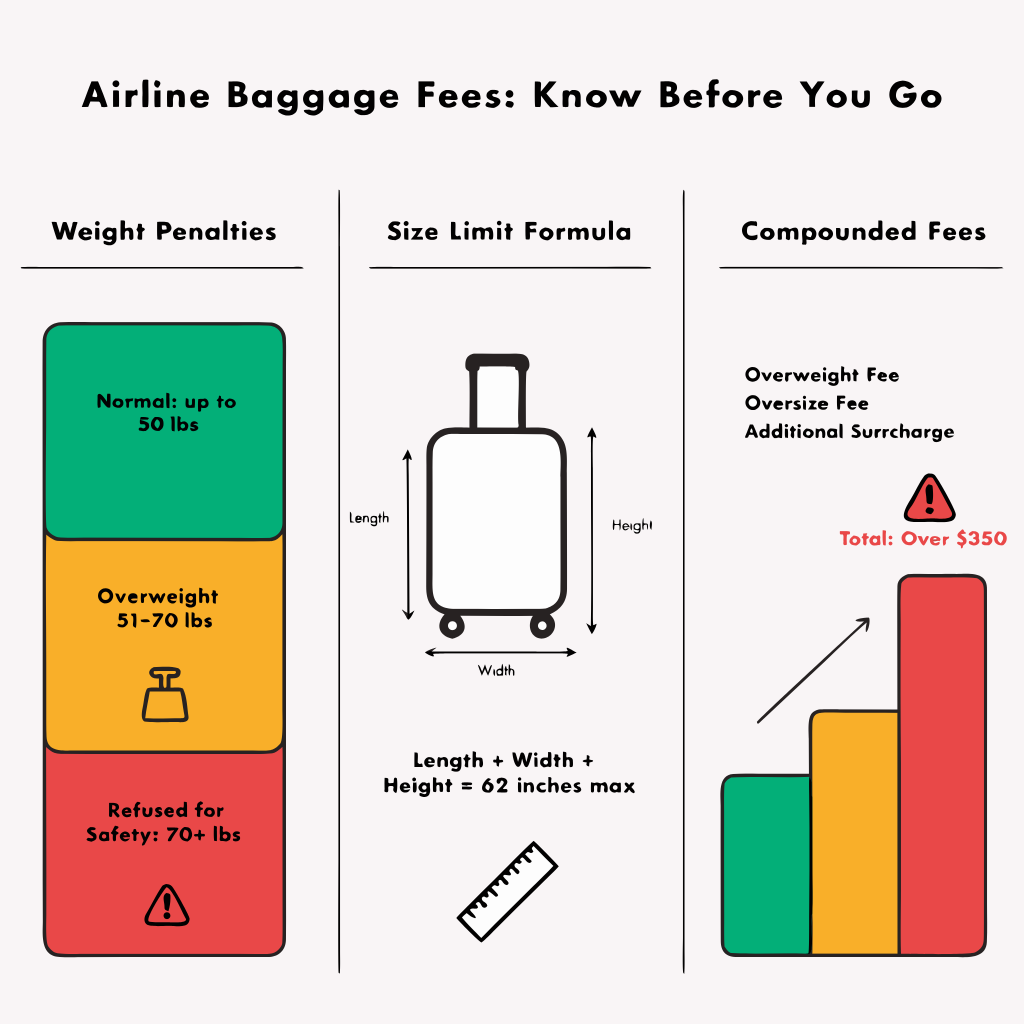
Once a bag exceeds 70 pounds, the penalty increases significantly, and most commercial airlines will refuse to transport any single bag weighing over 100 pounds (45 kilograms) due to safety regulations. Additionally, airlines calculate dimensional limits by adding the bag’s external length, width, and height (L + W + H). The standard maximum dimension for checked luggage is 62 linear inches. Exceeding this limit triggers an oversize fee that is assessed separately from overweight fees. If a bag is both overweight and oversize, the carrier will compound these charges. On a single domestic leg, a non-compliant bag can easily accumulate over $350 in fees, making it far more economical to split items into a second suitcase or use a dedicated cargo shipping service.
Strategic Packing and Equipment Selection
Avoiding unexpected baggage fees requires an analytical approach to equipment selection and packing. The first step is selecting luggage with a low physical tare weight—the weight of the empty suitcase itself. Heavy, hard-sided suitcases can weigh up to 12 pounds when empty, consuming nearly 25 percent of a standard 50-pound checked limit before any personal items are packed. Switching to modern, lightweight polycarbonate materials or high-durability nylon soft-sided bags can reclaim significant weight capacity.
Additionally, travelers should use a calibrated digital luggage scale to verify weights at home under controlled conditions. Weighing luggage on a bathroom scale is often inaccurate because these scales are not calibrated for the uneven weight distribution of a vertical suitcase. Furthermore, understanding the precise dimensions of personal items is critical. Many airlines strictly enforce a 18 x 14 x 8 inch limit for under-seat storage. Using a structured backpack that exceeds these dimensions can lead to gate agents requiring a gate-check, resulting in unexpected fees. Finally, travelers can strategically bypass these fees by utilizing co-branded airline credit cards, many of which waive standard checked bag fees for the cardholder and companions on the same reservation, completely neutralizing the standard fee structure.
Quick Summary
- Overage fees are structured as steep, flat-rate penalty tiers rather than progressive per-pound charges.
- Dimensional limits are calculated as total linear inches (L + W + H), with standard checked limits capped at 62 inches.
- Selecting lightweight luggage, pre-weighing bags, and utilizing co-branded credit cards are effective ways to eliminate baggage fees.
Conclusion: Long-Term Transit Efficiency
Navigating the modern aviation network requires a shift in perspective, moving from packing everything possible to systematically prioritizing physical items. By understanding the underlying physics, logistics, and regulations that govern airline baggage fees, travelers can make informed decisions that optimize both financial costs and travel comfort. Managing luggage weight and size is an intentional strategy that minimizes transit friction, eliminates cognitive load, and ensures complete control over one’s journey.