
Search Places to Stay & Save
Most travelers assume budget travel means choosing between affordability and enjoyment, but this framing misses the actual challenge. The problem isn’t that travel costs too much; it’s that most people approach trip planning without understanding where money actually goes and which trade-offs deliver real value versus which ones just limit experience.
As we move through 2026, travelers face continued pricing volatility across flights, accommodations, and activities. Destination costs vary wildly based on timing, booking patterns, and seasonal demand shifts that don’t always align with traditional peak seasons. The travelers who consistently spend less while traveling better aren’t following generic “hacks”—they’re making intentional allocation decisions based on cost structure realities that most people never examine.
This budget travel guide 2026 breaks down the actual mechanics of trip costs, explains which spending categories matter most, and shows you how to build a travel budget that works without requiring deprivation or constant price monitoring. The goal isn’t to travel as cheaply as possible. It’s to understand your costs well enough that you can make deliberate trade-offs that align with what you actually value.
Why Most Travel Budgets Fail Before You Even Leave
The typical approach to budget travel starts with an arbitrary spending limit, then attempts to force every booking decision into that constraint. This creates two predictable problems: either you compromise on elements that actually matter to your trip quality, or you exceed your budget on things that don’t.
Effective travel budgeting works in reverse. Start by understanding what a trip to your chosen destination actually costs across all major categories. Then decide which categories deserve premium allocation and which ones can absorb strategic cuts without degrading your experience. Most travelers find that they’re overspending in 2-3 categories that don’t significantly impact their trip satisfaction while underfunding the areas that would make the biggest difference.
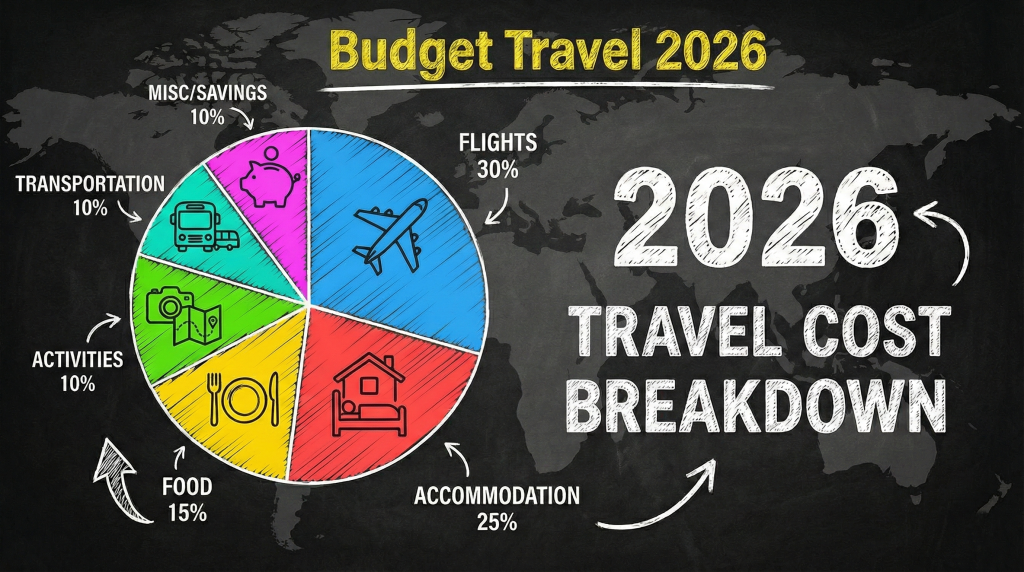
The most common budget failures come from treating all spending categories as equally flexible. They aren’t. Flight costs respond to booking timing but not to negotiation. Accommodation costs scale with location and timing but also with amenities you may not use. Food costs vary dramatically by dining approach but stabilize once you establish a pattern. Activity costs depend heavily on whether you’re booking packaged tours or arranging components independently.
When travelers understand these category mechanics, budget decisions become much clearer. You stop trying to save 10% everywhere and start making 30-50% reductions in areas that don’t impact your trip while protecting spending in categories that do.
The Five Core Cost Categories That Determine Your Total Trip Spend
Every trip breaks down into five fundamental spending categories, each with different cost behaviors and optimization opportunities. Understanding how these categories interact helps you see where flexibility exists and where it doesn’t.
Accommodation: Your Largest Single Expense
For most trips, accommodation represents 35-45% of total spending. This category offers the most dramatic cost variation based on location decisions within a destination, not just destination selection itself.
Travelers consistently underestimate how much accommodation costs shift based on neighborhood choice. A hotel 15 minutes from a city center often costs 40-60% less than comparable properties in the most central zones, but many travelers assume this distance sacrifice isn’t worth the savings. In practice, destination walkability and transit infrastructure determine whether this trade-off makes sense.
Mid-week stays generate automatic discounts in most markets because hotel occupancy drops substantially Monday through Wednesday. Weekend rates in major cities reflect convention demand and leisure travel patterns. Booking Tuesday-Thursday check-ins rather than Friday-Sunday often reduces costs by 20-30% for identical properties.
The all-inclusive versus à la carte decision significantly impacts both accommodation costs and total trip spending. All-inclusive resorts typically cost more per night but include meals, drinks, and basic activities. Whether this delivers value depends entirely on your consumption patterns. Travelers who eat two restaurant meals daily and have multiple drinks often find all-inclusive pricing saves money. Those who prefer lighter eating or exploring local dining options rarely benefit from the bundled pricing.
Key Takeaways
- Location flexibility within a destination delivers larger savings than choosing a cheaper destination
- Mid-week stays reduce accommodation costs more reliably than advance booking discounts
- All-inclusive pricing benefits high-consumption travelers but penalizes those seeking local dining experiences
Flights: Time-Sensitive But Less Flexible Than You Think
Airfare typically accounts for 15-25% of total trip costs for domestic travel and 30-40% for international destinations. Flight prices respond primarily to booking timing and route competition, not to negotiation or flexibility tactics that work in other categories.
The widely repeated advice to book flights on specific days of the week has lost most of its predictive value. Airlines now use dynamic pricing that adjusts in real-time based on demand signals across multiple routes. What matters more is booking window: 6-8 weeks ahead for domestic flights, 8-12 weeks for international travel. Booking too early rarely improves pricing because initial inventory releases carry premium pricing to capture business travelers.
Route competition creates the most significant pricing variation. Direct routes served by multiple carriers cost 20-40% less than routes requiring connections or served by single airlines. This means destination choice, not just booking timing, determines flight costs. Choosing destinations with competitive air service delivers more reliable savings than trying to optimize booking patterns to expensive, monopoly-route destinations.
Budget carriers have expanded significantly, but their total cost advantage has narrowed. Once you add fees for seat selection, checked bags, and carry-ons, many budget carrier tickets cost within 10-15% of legacy airline basic economy fares. The value proposition depends on your baggage needs and whether you’ll pay for seat selection anyway.
Food: The Most Controllable Variable Category
Food typically represents 15-25% of trip spending, and this category offers the most flexibility for cost reduction without significant experience degradation. The challenge is that most travelers approach food spending without any intentional strategy, leading to both overspending and occasional budget-driven restriction that diminishes trip enjoyment.
The most effective food budget approach isn’t eating cheap for every meal—it’s establishing a sustainable spending pattern that aligns with how you actually want to experience food while traveling. Many travelers find that one special meal per day combined with simpler, lower-cost options for remaining meals delivers better overall satisfaction than trying to maintain mid-range spending for every meal.
Local markets, grocery stores, and street food represent different cost-value equations across destinations. In Southeast Asia and Latin America, street food often delivers the most authentic culinary experience at the lowest cost. In Western Europe and major North American cities, grocery store assembly of breakfast and lunch components reduces costs substantially while reserving budget for dinner experiences.
The breakfast inclusion decision significantly impacts both accommodation choice and food budgets. Hotels including breakfast typically charge $15-40 more per night. Whether this delivers value depends on your breakfast preferences and local breakfast costs. In destinations where quality breakfast options cost $12-18, included breakfast often saves money. In areas with excellent $4-6 local breakfast options, paying for hotel breakfast inclusion rarely makes sense.
Activities and Excursions: Where Personalization Costs Add Up
Activities account for 15-25% of trip spending, with significant variation based on destination type and travel style. Beach destinations with free coastal access naturally reduce activity costs. Cities requiring paid museum entry, guided tours, or ticketed attractions push this category higher.
The packaged tour versus independent exploration trade-off involves more than just cost comparison. Packaged tours bundle transportation, admission, and guide services, typically costing 30-50% more than arranging the same components independently. But they also eliminate research time, navigation challenges, and scheduling complexity. Whether this premium delivers value depends on your comfort with independent travel and the destination’s infrastructure for independent visitors.
Free walking tours have expanded significantly across major tourism cities. These tours operate on a tip-based model, typically costing $10-20 per person compared to $40-80 for paid equivalents. Quality varies, but many free walking tours match or exceed paid versions in content and guide expertise.
Many destinations offer city passes bundling multiple attraction entries and transit access. These passes save money only when your itinerary already includes the bundled attractions. Travelers often purchase passes expecting to “get their money’s worth” by visiting more attractions than they would otherwise choose. This creates a false economy where you’re paying for attractions you wouldn’t have selected independently.
Transportation and Miscellaneous: The Hidden Cost Accumulation
Local transportation and miscellaneous expenses account for 10-15% of total trip spending, but these costs often exceed expectations because they accumulate through small, frequent transactions rather than a few large purchases.
Airport transfers represent one of the first decision points, with costs ranging from $10 for public transit to $60-100 for private car services. The comfort premium for private transfers rarely justifies the cost for solo travelers or couples, but groups of 3-4 people often find that splitting a private transfer costs less per person than individual transit tickets while eliminating navigation complexity.
Rental cars introduce both direct costs (rental fees, insurance, fuel) and indirect costs (parking, toll roads, navigation time). For urban destinations with strong public transit, rental cars typically cost more than they save. For rural destinations, multi-destination road trips, or travel with children, rental cars often reduce total transportation costs while improving flexibility.
Daily tipping, small purchases, and incidental costs create budget leakage that most travelers underestimate by 30-50%. These aren’t “unexpected” costs—they’re predictable but distributed expenses that don’t feel significant individually. Building a 10-15% buffer into your budget specifically for these distributed costs prevents the common experience of exceeding your planned spending despite careful tracking of major categories.
Strategic Timing: When You Travel Matters More Than Where
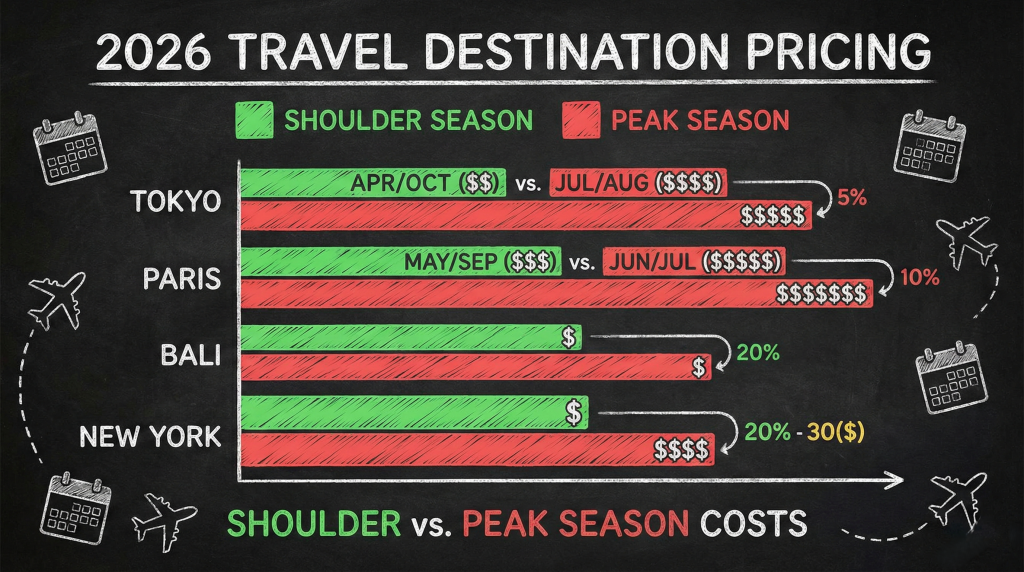
Destination costs fluctuate dramatically based on seasonal demand patterns, but these patterns don’t align perfectly with weather or school vacation calendars. Understanding destination-specific timing dynamics often delivers larger savings than choosing a cheaper destination.
The Shoulder Season Advantage
Shoulder seasons—the periods immediately before and after peak tourism windows—typically offer 30-40% cost reductions across accommodation and activities while maintaining favorable weather. But shoulder season timing varies significantly by destination type.
Beach destinations in the Caribbean and Mexico see peak pricing from December through March, with shoulder seasons in April-May and October-November. Mediterranean Europe peaks in July-August, with excellent value in May-June and September-October. Southeast Asian destinations follow inverse patterns, with peak season during North American winter months.
Shoulder season travel delivers its best value when you can accept slight weather variability without it disrupting your trip. Destinations where weather reliability matters less—cities with museum and cultural focus rather than beach destinations—offer better shoulder season experiences than locations where your activities depend on specific conditions.
Avoiding High-Compression Windows
High-compression windows occur when multiple demand factors combine to drive up prices and reduce availability. Spring break weeks in March, Thanksgiving week in the U.S., Christmas through New Year’s, and summer months in family-focused destinations create compression regardless of typical seasonal patterns.
Traveling one week before or after these windows generates substantial savings. A Mexico beach resort that costs $280 per night during spring break often drops to $160 per night the week before or after, with identical weather and services. Flight prices follow similar patterns, with compression-week flights costing 40-60% more than adjacent weeks.
Major events—festivals, conventions, sporting events, conferences—create localized compression that can double typical accommodation costs. Checking destination event calendars before finalizing dates helps identify these compression periods. The challenge is that many major events don’t appear in standard search results, requiring destination-specific research.
The Booking Window Sweet Spot
Booking timing influences both cost and availability, but the relationship isn’t linear. Booking too far in advance or too close to travel dates both typically increase costs.
For flights, the 6-12 week booking window delivers the most favorable pricing for most routes. Airlines release inventory 11 months ahead but initially price it for business travelers. Prices typically drop 4-5 months out as airlines gauge demand, then rise steadily as departure approaches and seats fill.
Accommodation booking windows vary by property type and destination. Hotels in major cities offer best pricing 2-4 weeks ahead as they adjust inventory for actual demand versus forecast. Vacation rentals typically require longer booking windows, with 6-8 weeks ahead delivering best availability and pricing.
Last-minute deals exist but carry significant risk. Hotels and vacation rentals sometimes discount unsold inventory 1-2 weeks before check-in, but this works only when you have date and destination flexibility. Building a trip around hoped-for last-minute deals often costs more than booking within the standard optimal window.
Building Your Actual Trip Budget: A Five-Step Framework
Effective budget creation starts with cost reality, then adjusts for your priorities and constraints. This approach produces budgets that reflect actual spending rather than aspirational limits that create false constraints.
Step 1: Calculate Baseline Costs
Start by researching actual costs for your chosen destination during your planned travel dates. This means checking specific accommodation pricing, typical flight costs for your departure city, average meal costs from recent traveler reports, and entrance fees or activity costs for attractions you plan to visit.
Don’t use averages from travel cost calculators or year-old blog posts. Costs shift significantly year-over-year, and generic averages don’t reflect specific timing or neighborhood choices. Spend 2-3 hours gathering current pricing from booking platforms, destination forums, and government tourism sites.
This baseline should cover all five major categories with destination-specific pricing. If accommodation in your chosen neighborhood costs $120-150 per night, budget $135. If flights typically cost $380-450 round-trip, budget $415. Slight overestimation in baseline calculations prevents budget failure more effectively than exact estimates.
Step 2: Identify Your Non-Negotiable Elements
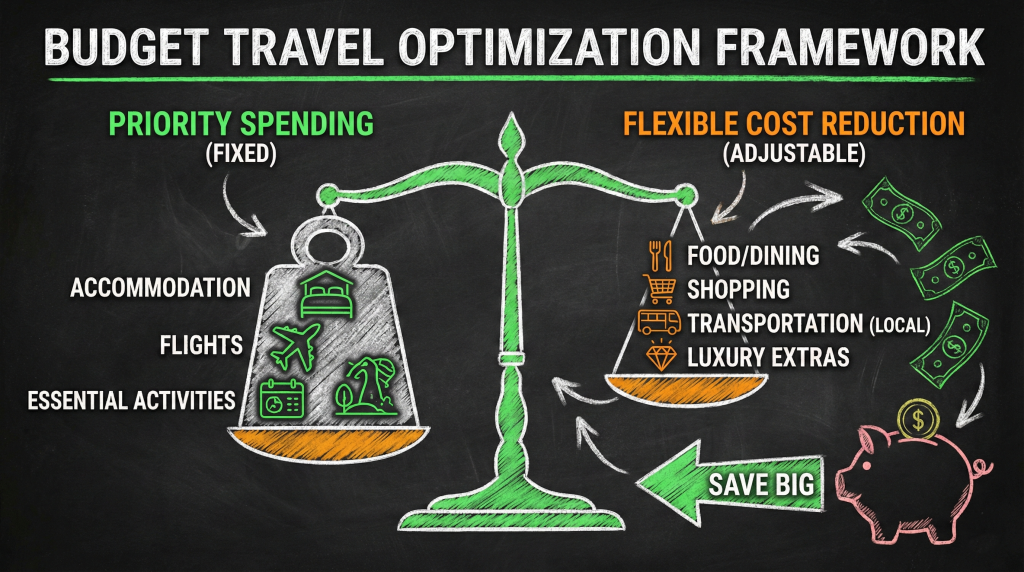
Every traveler has 2-3 elements that significantly impact their trip satisfaction. These non-negotiables should receive full baseline funding without cost reduction attempts. Trying to economize on elements that matter most to your travel experience creates regret and often leads to mid-trip spending increases anyway.
Common non-negotiables include accommodation location for travelers who value walkability, food experiences for culinary-focused trips, or specific activities that justified choosing the destination. These priorities vary by individual and by trip, but identifying them explicitly before budget allocation prevents the mistake of treating all categories as equally flexible.
Once you’ve identified non-negotiables, protect their baseline budget allocation. The remaining categories become your optimization targets.
Step 3: Determine Flexible Categories for Cost Reduction
With non-negotiables identified, examine remaining categories for optimization opportunities that won’t significantly degrade experience. This requires honest assessment of what actually impacts your trip satisfaction versus what you think should matter.
Many travelers discover they care much less about accommodation amenities than they assumed, especially for destination-focused trips where they spend minimal time in their room. Others find that expensive packaged tours don’t deliver meaningfully better experiences than well-researched independent exploration. These realizations open significant budget flexibility.
The key question isn’t “How can I spend less?” but rather “What would I genuinely not miss?” Categories where you can reduce spending by 30-50% without noticing the difference during your trip represent true optimization opportunities.
Step 4: Add Strategic Buffers and Contingency
Your baseline calculations cover expected costs, but trips generate both predictable and unpredictable additional expenses. Building specific buffers into your budget prevents the stress of exceeding planned spending.
A 10-15% contingency buffer covers distributed costs—tips, small purchases, occasional taxi rides, snacks and drinks. These expenses individually feel negligible but accumulate to meaningful amounts. Treating them as discretionary rather than budgeting explicitly for them leads to either constant spending anxiety or budget overruns.
A 5-8% emergency buffer covers genuinely unexpected costs—delayed flights requiring additional accommodation, medical needs, replacing damaged items, itinerary changes due to weather. You may not need this buffer, but having it provides significant peace of mind.
In Short
- Start with destination-specific current pricing, not generic averages
- Fully fund the 2-3 elements that most impact your trip satisfaction
- Reduce spending in categories you genuinely won’t miss
- Budget explicitly for distributed and contingency costs rather than treating them as exceptions
Step 5: Validate Against Total Available Funding
With all categories estimated and buffers added, compare your total budget to available funding. If the total exceeds your resources, you face three options: adjust timing to reduce costs, modify destination choice, or reduce trip duration.
Adjusting timing often delivers the largest cost reduction with least impact to experience. Moving your trip by 2-4 weeks to capture shoulder season pricing can reduce total costs by 25-35% while maintaining the core destination experience.
Destination modification becomes necessary when timing adjustments don’t create sufficient savings. This doesn’t mean abandoning your plans entirely—it means identifying destinations that deliver similar experiences at lower baseline costs. If Mexican Caribbean resorts exceed your budget, Pacific coast Mexico destinations often cost 30-40% less with comparable beach quality.
Reducing trip duration represents the last optimization lever. Shorter trips reduce accommodation and food costs linearly but rarely reduce flight costs proportionally. A 7-day trip typically costs 60-70% of a 10-day trip, not 70% as pure math would suggest.
Category-Specific Optimization: Where to Actually Cut Costs
Once you understand your budget structure and priorities, effective optimization requires category-specific strategies that reduce costs without degrading experience.
Accommodation Optimization: Location and Amenity Trade-Offs
The most impactful accommodation optimization involves location flexibility within your destination. Central neighborhoods command premium pricing, but many destinations have equally attractive areas 15-20 minutes from the center that cost substantially less.
Research transit connections, not just distance. A property 3 miles from the center with poor transit access creates more friction than one 6 miles out with direct metro access. Time-to-destination via transit matters more than geographic distance.
Amenity elimination offers another optimization path. Many hotels charge premium pricing for pools, fitness centers, and breakfast inclusion that you may not use. Properties without these amenities often cost 20-30% less with identical room quality and location. Honest assessment of which amenities you’ll actually use during your trip eliminates paying for features that don’t impact your experience.
Vacation rentals vs. hotels presents a cost-experience trade-off that varies by trip length and group size. Rentals typically cost less per night for groups of 3+ people and offer kitchen access that reduces food costs. They also require more planning for check-in logistics and lack daily service. For trips under 4 days, operational convenience usually favors hotels. For weeks-long stays or family groups, rentals often deliver better value.
Flight Optimization: Routes and Flexibility
Route flexibility provides more significant flight savings than booking timing optimization. If you’re targeting beach destinations, comparing costs for different Caribbean or Mexican airports often reveals 30-50% pricing differences for similar destination experiences.
Major hub connections typically cost less than direct flights to smaller airports. The time-cost trade-off requires personal evaluation: a 3-hour layover that saves $180 might make sense for budget-focused travelers but not for those prioritizing travel time efficiency.
Midweek flights consistently cost 15-25% less than weekend departures and returns. If your work schedule allows Tuesday-Wednesday outbound and return flights, this timing shift delivers automatic savings without any experience compromise.
Food Strategy: Mixing Splurge Meals with Strategic Savings
The most satisfying food budget approach establishes a clear spending hierarchy: one premium meal per day, with remaining meals optimized for value rather than experience.
This pattern lets you enjoy destination-specific culinary experiences without feeling budget-constrained while simultaneously creating substantial savings. A $60 dinner preceded by a $6 breakfast and $12 lunch costs much less than three $25 meals while typically delivering better overall food satisfaction.
Grocery stores and markets work differently across destinations. In Western Europe, supermarket-assembled lunches cost $5-8 versus $15-25 for cafe meals. In Southeast Asia, the cost difference shrinks and local eateries often provide better food quality than Western-style grocery options.
Alcohol represents a significant food budget variable. Drinks with dinner easily add $15-30 per person to meal costs. Travelers who enjoy alcohol but want to control costs often find that limiting drinks to one special meal per day rather than eliminating them entirely maintains satisfaction while reducing costs substantially.
Activity Selection: Free and Low-Cost Alternatives
Many destinations offer free or low-cost alternatives to paid tours and attractions that deliver comparable experiences with better flexibility.
Walking tours, whether free or paid, provide destination orientation and historical context at lower cost than bus tours or private guides. They work best early in a trip, establishing familiarity that makes independent exploration easier for remaining days.
Natural attractions—beaches, parks, hiking trails, public spaces—cost nothing but often represent a destination’s most memorable experiences. Destinations with significant free natural access often deliver better budget-travel value than cities where major attractions require paid admission.
Museums and cultural sites typically offer free or discounted admission on specific days or times. Many museums waive admission one evening per week or on first Sundays. Planning your itinerary around these windows captures cultural experiences without full admission costs.
Advanced Budget Travel Patterns for Frequent Travelers
Once you understand fundamental budget mechanics, several advanced patterns can reduce costs for travelers who make multiple trips per year or extended journeys.
Slow Travel and Extended Stays
Extending stays at individual destinations reduces per-day costs through weekly or monthly accommodation discounts while simultaneously reducing transportation costs by eliminating frequent inter-destination moves.
A 10-day stay in one location typically costs 30-40% less than five 2-day stops because accommodation, local transport, and food establish patterns that reduce decision friction and optimize spending. Many vacation rentals offer weekly discounts of 15-25%, and monthly stays sometimes reduce costs by 40-50% compared to daily rates.
Slow travel also improves experience quality. The constant movement of quick destination-hopping creates fatigue and reduces ability to discover local patterns and preferences. Most travelers find that 4-5 days minimum per destination delivers better satisfaction than rapid movement, while also costing less.
Strategic Home Basing
Choosing a single affordable destination as a base for 2-4 weeks, then taking short trips to nearby locations, often costs less than point-to-point travel between multiple destinations. This pattern works particularly well for regions with strong local transport connections like Europe or Southeast Asia.
A two-week base in Lisbon or Chiang Mai with weekend trips to surrounding areas costs substantially less than booking separate accommodations for 2-3 day stays in multiple cities. You negotiate better monthly rates, reduce packing and unpacking friction, and eliminate constant accommodation research and booking.
Off-Peak Long-Duration Travel
For travelers with schedule flexibility, long trips during destination off-seasons can deliver extraordinary value. A month in the Caribbean during summer or Southeast Asia during monsoon season costs 50-60% less than peak season travel.
This approach requires accepting weather variability and reduced service levels. Many businesses reduce hours or close entirely during deep off-seasons. But for travelers who can tolerate occasional rain and appreciate quieter destinations, off-peak extended travel often delivers the best overall value in budget travel.
Budget Tracking During Your Trip: Staying On Target Without Constant Monitoring
Once you’ve built a thoughtful budget and started traveling, tracking actual spending provides feedback without requiring obsessive receipt recording.
The Daily Allowance Method
Rather than tracking every transaction, establish a daily allowance that covers all variable costs—food, local transport, activities, miscellaneous purchases. Fixed costs like accommodation and flights were already paid, so daily tracking needs to cover only discretionary spending.
Withdrawing 3-4 days of allowance in cash at a time makes spending immediately visible. When your cash runs low, you know you’re approaching your daily limit without any calculation required. This method works particularly well in destinations where cash remains primary.
For card-dominant destinations, checking your account balance every 2-3 days provides similar feedback. The goal isn’t transaction-level precision but rather ensuring you’re roughly tracking to your planned spending rate.
The Category Review Approach
For travelers who prefer less frequent monitoring, reviewing spending by category every 3-4 days helps identify whether any category is significantly exceeding budget. If accommodation is on target but food costs are running 50% over budget, you can adjust for remaining days without needing to change your entire spending pattern.
This approach acknowledges that daily spending fluctuates naturally. Some days involve expensive activities or special meals while others cost very little. Category-level tracking smooths these fluctuations and focuses attention on actual budget concerns rather than normal daily variation.
Mid-Trip Budget Adjustments
If you discover mid-trip that you’re significantly over or under budget, making deliberate adjustments prevents both budget failure and unnecessary restriction.
Running under budget might mean you’re being more restrictive than necessary. Consider adding one premium experience or special meal to remaining days. The goal of budget travel is getting maximum value from available resources, not spending the absolute minimum.
Running over budget requires honest assessment of whether overspending is occurring in your prioritized categories or in areas that don’t meaningfully impact your experience. If you’re exceeding budget on non-priorities, make clear cuts in those categories for remaining days. If you’re over on priorities, either accept the overrun or reduce spending in other categories to compensate.
Common Budget Travel Mistakes That Cost More Than They Save
Even experienced travelers sometimes make optimization decisions that reduce costs in the moment but create larger expenses or experience degradation later.
False Economy in Accommodation Location
Choosing accommodation significantly far from your planned activities to save $20-30 per night often increases transportation costs and time while reducing spontaneous exploration. When daily transit to main areas costs $8-12 round-trip and requires 45 minutes each way, the accommodation savings disappear while opportunity costs increase.
Calculate total location cost—accommodation plus transport plus time—rather than just nightly rate. Properties that cost more per night but reduce transportation needs often deliver better overall value.
Skipping Travel Insurance for “Low-Risk” Trips
Budget travelers often skip travel insurance to save $40-80, viewing it as unnecessary for healthy travelers on short trips. But insurance value comes from catastrophic risk coverage, not likely events.
A medical emergency requiring evacuation or hospital care, a missed flight connection requiring rebooking, or lost baggage with essential items can each cost thousands. Insurance premiums cover these tail risks. The “low-risk” calculation often focuses on whether you’ll use the insurance (probably not) rather than whether the risk, if realized, would create financial hardship (often yes).
Extreme Budget Restriction Creating Mid-Trip Splurges
Setting unrealistically low budgets forces constant cost optimization that creates decision fatigue and restriction-resentment. This often leads to mid-trip abandonment of budget discipline with resulting overspending that exceeds what you would have spent with a realistic initial budget.
This pattern is particularly common with food budgets. Travelers who try to minimize food costs for several days often reach a breaking point and overspend dramatically on one or two meals as a response to feeling deprived. Setting a moderate food budget from the beginning typically results in lower total spending and better overall satisfaction.
Booking Without Understanding Cancellation Terms
Saving $15 on a non-refundable accommodation booking seems smart until circumstances change and you lose the entire prepayment. Budget-focused travelers often prioritize lowest price without evaluating cancellation flexibility.
Paying slightly more for refundable bookings provides insurance against itinerary changes, health issues, or work conflicts. The premium for flexibility typically costs 10-20% more but eliminates risk of losing entire prepayments if you need to cancel.
Making Budget Travel Sustainable: Approaches That Work Long-Term
Budget travel approaches that require constant attention, sacrifice, or restriction rarely work for multiple trips. Sustainable budget travel means developing patterns and principles that reduce costs naturally without ongoing optimization effort.
Establish Reliable Default Strategies
Once you identify budget approaches that work well for you—specific accommodation types, food patterns, activity selection methods—codify them as your default approach rather than re-researching every trip.
If you consistently find that mid-range vacation rentals with kitchens deliver best value for trips over 5 days, make that your default accommodation search rather than comparing every option each time. If free walking tours followed by independent museum visits provide your preferred cultural experience pattern, repeat that approach rather than evaluating packaged tour options.
Defaults reduce decision friction and research time while maintaining cost efficiency. You’re not eliminating all trip-specific research—you’re eliminating re-evaluation of fundamental patterns that you’ve already validated as working well for you.
Build Destination Knowledge Over Time
Returning to destinations you’ve visited before eliminates massive research requirements while improving ability to optimize spending through local knowledge. Second and third visits cost less than first visits because you’ve already learned which neighborhoods offer best value, which restaurants deliver quality at lower prices, and which activities provide meaningful experiences versus tourist traps.
Many budget travelers focus exclusively on visiting new destinations, but occasionally returning to places you already know well can deliver better overall travel value while requiring less planning effort and cost.
Separate Budget from Deprivation
The most successful long-term budget travelers view their budgeting as intentional allocation rather than restriction. They’re not trying to minimize spending—they’re trying to maximize value from available resources by funding priorities appropriately and reducing spending in areas that matter less to them.
This mindset shift prevents the burnout that comes from viewing budget travel as constant sacrifice. When your budget reflects your actual priorities, staying within it feels like successful planning rather than restriction.
Conclusion
Budget travel in 2026 isn’t about following a universal list of hacks or restricting yourself to the cheapest options in every category. It’s about understanding how trip costs actually work, identifying what you genuinely value, and making deliberate trade-offs that align spending with priorities.
The travelers who consistently get the most value from their budgets share a common approach: they invest time in understanding destination-specific cost structures, they protect spending on elements that most impact their satisfaction, and they reduce costs aggressively only in categories that genuinely don’t matter to their experience.
Your budget travel approach should feel sustainable rather than sacrificial. When you’re making spending decisions that align with your actual priorities, staying within budget becomes a natural outcome of good planning rather than a constant battle with restriction. The goal is enjoying travel at a cost you can afford repeatedly, not maximizing either savings or spending, but rather optimizing the relationship between cost and value for the kind of travel experiences you most want to have.
External Link Recommendation Table
| Source | Why It’s Useful | Link |
|---|---|---|
| U.S. Bureau of Transportation Statistics | Historical domestic airfare data used to verify seasonal and route-based pricing patterns. | transtats.bts.gov |
| U.S. Department of State | Official destination entry requirements, visa costs, and travel advisories that affect trip budgeting. | travel.state.gov |
| Eurostat | EU tourism statistics on accommodation pricing and seasonal demand trends across member states. | ec.europa.eu/eurostat/web/tourism |
| OECD | Cross-country tourism trend and policy analysis used to contextualize pricing volatility. | oecd.org/en/topics/tourism |
| UN Tourism (UNWTO) | World Tourism Barometer data on global travel demand and seasonal shifts. | unwto.org |
Where to Book
| Platform | Best For | Link |
|---|---|---|
| Booking.com | Hotels and budget-to-mid-range accommodation comparisons | Booking.com |
| Airbnb | Vacation rentals and longer stays with kitchen access | Airbnb |
| Hostelworld | Hostels and shared-room budget stays | Hostelworld |
| Google Flights | Flight price tracking and fare comparison across airlines | Google Flights |
| Klook | Tours, activities, and airport transport bundled at destination | Klook |
| GetYourGuide | Independently bookable tours and skip-the-line activities | GetYourGuide |