

Search Places to Stay & Save
Most travelers struggle to find cheap flights tips that actually deliver savings—they pick dates and destinations first, then wince at the prices. The assumption is that airfare follows some hidden logic accessible only to industry insiders or those willing to refresh search pages at 1 AM on Tuesdays. Neither is true. The best find cheap flights tips aren’t about gaming the system or discovering secret booking windows—they’re about understanding how airline pricing actually works, then building search and timing strategies around that reality.
The uncomfortable truth is that identical seats on the same flight can vary by hundreds of dollars depending on when you search, how you route, and whether you’re willing to adjust even slightly on timing or destination. Airlines use dynamic pricing models that shift multiple times per day based on demand patterns, competitor fares, and remaining inventory. This creates both frustration and opportunity. Travelers who apply proven find cheap flights tips and build flexibility into their approach consistently secure fares 40-60% below what others pay for equivalent routes.
What follows isn’t a list of booking hacks or psychological tricks. These are structural strategies backed by pricing data and traveler behavior patterns. Some require advance planning. Others work for last-minute departures. All prioritize actual savings over the illusion of control that comes from booking on specific days or clearing browser cookies. The goal isn’t to outsmart airlines—it’s to align your search behavior with how their pricing systems actually function.
Understanding How Airline Pricing Actually Works
Before diving into tactical strategies, it’s worth understanding why flight prices behave so erratically. Airlines don’t set fares based on distance, fuel costs, or operational expenses in any straightforward way. They use revenue management systems that constantly adjust pricing based on predicted demand for specific routes and departure times. A seat isn’t worth a fixed amount—it’s worth whatever the airline believes someone will pay for it at any given moment.
This creates what economists call “price discrimination,” where the same product (a seat) sells at different prices to different customers. Business travelers booking last-minute departures pay premium rates. Leisure travelers planning months ahead get access to lower fare buckets. The system rewards flexibility and punishes urgency, which is why most booking strategies focus on expanding your options rather than narrowing them.
Airlines release seats in fare classes, often called “buckets.” Within each flight, there might be 7-10 different price points for the same economy seat depending on booking restrictions, change fees, and refund policies. When you search for multiple tickets, the system shows you the price for the lowest bucket that has enough seats available. If only one cheap seat remains but you’re booking for three people, you’ll see the next bucket up—even though that single cheap seat exists. This bucket structure explains many of the seemingly arbitrary price jumps travelers encounter.
The other major factor is route competition. Routes with multiple carriers competing for passengers see lower average fares and more frequent sales. Routes dominated by a single airline or with limited service typically maintain higher baseline prices with fewer discounts. This is why flying from major hubs almost always offers better deals than departing from smaller regional airports, even when the distance to your destination is similar.
Quick Summary
- Airlines use dynamic pricing that changes multiple times daily based on demand predictions, not fixed cost structures
- Fare buckets create price tiers within the same flight, rewarding early bookers and punishing inflexibility
- Route competition directly impacts baseline pricing—more carriers competing means lower average fares and more sales
Search Tools and Price Monitoring
The foundation of finding cheap flights is using the right search infrastructure. Flight comparison engines aggregate fares across multiple airlines and booking platforms, doing in seconds what would take hours manually. Google Flights has become the standard for most travelers due to its speed, calendar view for price comparison, and ability to search flexible dates and nearby airports simultaneously. Skyscanner offers similar functionality with a slightly different interface and occasionally catches fares Google misses.
The critical insight here is that these tools aren’t just for comparing prices—they’re for expanding your awareness of what’s actually available. Most travelers search for specific dates to specific destinations, see expensive results, and either book or give up. Search engines with flexible date calendars let you see pricing across entire months, often revealing that shifting your trip by 48 hours could save $200 per ticket. The “explore” features on these platforms take this further, showing you where you can fly for specific budgets rather than what it costs to reach predetermined destinations.
Setting price alerts is the passive version of this strategy. Rather than manually checking fares every few days, you configure monitoring for specific routes and receive notifications when prices drop. This works best when you have destination flexibility or long booking windows. The limitation is that alerts only track routes you’ve explicitly configured, so they won’t catch deals to nearby cities or alternative airports that might offer better value.

Fare comparison engines have blind spots. Southwest Airlines doesn’t participate in most aggregators and requires direct searches on their website. The same applies to some international low-cost carriers. Additionally, meta-search sites sometimes display cached prices that are no longer available, or they route you to third-party booking agents whose prices include hidden service fees. For confirmed booking, cross-reference the final price on the airline’s own website before purchasing.
In Short
- Comparison engines aggregate multiple sources and reveal pricing patterns across date ranges, not just point-in-point fares
- Price alerts work for predetermined routes but won’t catch alternative routing or nearby airport deals
- Direct airline searches remain necessary for carriers that don’t participate in aggregators
Date and Destination Flexibility
The single most effective way to reduce airfare costs is flexibility—not as a vague preference but as a structured search approach. Travelers who commit to specific dates and destinations before checking prices routinely overpay by 30-50% compared to those who build their plans around fare availability. This doesn’t mean abandoning your vacation preferences entirely. It means considering whether flying out on Wednesday instead of Friday matters enough to justify an extra $180, or whether visiting Porto instead of Lisbon changes your trip in ways that outweigh a $300 fare difference.
Flexibility works because airline pricing is hyperlocalized. A route from New York to Madrid might cost $800 on July 15th but $450 on July 12th for reasons entirely unrelated to you—competing airlines launched sales, a large conference ended, or the algorithm predicted lower demand that week. If your schedule allows even a 3-4 day window, you’re not at the mercy of whatever price happens to exist for your predetermined date. You’re choosing from a range of options, some of which will be significantly cheaper than others.
Destination flexibility operates on the same principle but at a larger scale. If your goal is “Mediterranean beach vacation in September” rather than “Barcelona September 8-15,” you’ve opened up dozens of routes and thousands of fare combinations. Tools like Google Flights Explore Map show you the cheapest destinations from your home airport within a given timeframe or budget. This inverts the normal booking process: instead of asking “what does it cost to go where I want?”, you’re asking “where can I go for what I’m willing to pay?”
The practical application requires some mental reframing. Most people feel like destination and dates should come first because that’s how vacation planning has always worked. But if saving money is the priority, the sequence reverses. You identify cheap flights first, then build your trip around them. This works especially well for travelers who value experience over itinerary—those who care more about “European cities” than specifically Paris, or “warm beach” over definitively Cancún.
There are limits to this approach. If you’re visiting family, attending a wedding, or tied to school schedules, flexibility isn’t a realistic option. For these trips, the strategies shift toward optimizing within constraints rather than expanding them. But for discretionary travel—the majority of leisure bookings—flexibility is the single highest-leverage variable in the cost equation.
Booking Windows and Timing Strategies
Conventional wisdom about booking “exactly 54 days in advance” or “on Tuesday afternoons” is mostly myth perpetuated by outdated studies and confirmation bias. Airlines adjust prices continuously, not according to day-of-week patterns. There is no magic booking day. What does exist is a booking window—a general timeframe when fares are statistically more likely to be at their lowest before last-minute demand drives prices up.
For domestic flights, this window is typically 1-3 months before departure. For international routes, it extends to 2-8 months out. These ranges aren’t precise predictions—they’re observations about when airlines have released enough inventory to fill the plane but haven’t yet entered the final demand-driven pricing phase. Booking too early (6+ months for domestic, 10+ months for international) means paying the higher introductory fares airlines set before sales pressure forces adjustments. Booking too late means competing with business travelers and others with schedule constraints who’ll pay whatever’s available.
Peak travel seasons compress these windows. Summer travel to Europe or holiday flights to major U.S. cities need earlier booking—often 4-6 months ahead—because demand is predictable and seat inventory disappears faster. Off-season travel to the same destinations can follow the standard windows or even benefit from last-minute sales when airlines realize planes won’t fill at normal prices.
The nuance here is that “booking within the window” doesn’t mean waiting until you’re inside it to start searching. It means monitoring prices as they approach the window, then booking when you see fares drop into the range that historical data suggests is the floor for that route. Price tracking tools that show trend lines help calibrate this judgment. If fares are at $650 three months out and the historical low for that route is $580, waiting makes sense. If they’re at $580 and trending upward, booking immediately is the move.
Key Takeaways
- Booking windows are observation-based timeframes (1-3 months domestic, 2-8 months international), not precise prediction formulas
- Peak season compresses windows—book earlier for summer and holiday travel
- Monitor price trends approaching the window, book when fares reach historical lows for the route
Days of Week and Seasonal Patterns
While the day you book doesn’t matter, the day you fly absolutely does. Midweek departures—particularly Tuesday, Wednesday, and Saturday—consistently show lower average fares than Friday and Sunday flights. The reason is demand composition. Business travelers who expense flights cluster on Monday mornings and Friday evenings. Weekend leisure travelers prefer Friday departures and Sunday returns. Airlines price to match this demand pattern, charging premiums when seats fill faster and discounting when planes would otherwise fly with empty rows.
The savings from flying on cheaper days typically range from $50-150 per ticket on domestic routes and $100-300 on international flights. For a family of four, that’s $400-1,200 in potential savings just from adjusting departure dates by 48 hours. The trade-off is convenience—midweek travel may cost you an extra vacation day or require missing work. Whether that’s worthwhile depends on your income, available time off, and how much you value the savings versus schedule convenience.
Seasonal patterns operate at a larger scale but follow similar logic. Peak travel seasons—summer for most destinations, winter for tropical locations, holidays across the board—see baseline fare increases of 40-60% compared to shoulder seasons. This isn’t gouging; it’s supply and demand. More people want to travel when weather is best and schools are on break, so airlines can charge more. The inverse holds for off-season travel. Flights to Europe in November cost considerably less than July departures to the same cities, not because the service differs but because fewer people are competing for seats.

The strategic application is straightforward: if your schedule allows off-season travel, that’s where the largest per-trip savings exist. But off-season has trade-offs beyond just weather. Some attractions close, events and festivals may not run, and certain destinations lose their appeal entirely (beach towns in winter, ski resorts in summer). The question isn’t whether off-season is cheaper—it always is—but whether what you lose in experience value is worth what you gain in cost savings.
For travelers locked into peak-season timing due to work or family constraints, the day-of-week strategy becomes more important. Even during summer or holidays, Tuesday/Wednesday/Saturday departures will be cheaper than Friday/Sunday equivalents, just at higher baseline prices. Small optimizations compound when you’re already paying premium seasonal rates.
Low-Cost Carriers and Budget Airlines
Budget airlines have fundamentally changed the flight booking landscape by offering baseline fares significantly below legacy carriers, often 30-50% less on overlapping routes. The catch is that these fares are truly baseline—just the seat and limited personal item space. Everything else (checked bags, carry-ons, seat selection, snacks, priority boarding) costs extra. For travelers who can pack light and don’t need amenities, this unbundling creates genuine savings. For those who do need extras, the total cost sometimes exceeds what legacy carriers charge for the same route with inclusions.
The math requires calculation, not assumption. A $79 flight on Spirit looks appealing until you add $65 for a checked bag, $35 for carry-on, and $15 for seat selection—suddenly you’re at $194 for a service package that United sells for $180 with everything included. But if you’re genuinely traveling with just a backpack and don’t care where you sit, that $79 fare is legitimately cheaper. The savings exist, but only for travelers whose needs align with the bare-bones service model.
Regional budget carriers often offer the best deals on short routes where legacy airline pricing has remained high due to limited competition. In Europe, Ryanair and EasyJet have made previously expensive intra-continental travel accessible at $20-60 per segment. In the U.S., Frontier and Allegiant serve secondary markets at prices that undercut major carriers by 40%+. In Asia and Latin America, similar dynamics play out with region-specific low-cost operators.
The reliability question is legitimate. Budget airlines have statistically higher cancellation and delay rates, largely because they run tighter schedules with less buffer for disruptions and fewer backup aircraft. When delays occur, rebooking options are often more limited than with major carriers who can shift you to partner airlines. For non-time-sensitive leisure travel, this is usually manageable. For trips where missing a connection has high consequences (cruises, weddings, international connections), the savings may not justify the risk.
What This Means
- Budget airline savings are real but conditional—calculate total cost including all necessary extras before booking
- Short routes and secondary markets see the largest price advantages compared to legacy carriers
- Higher delay/cancellation rates make budget carriers riskier for time-sensitive trips where missing connections carries high costs
Alternative Routing and Multi-City Strategies
The direct path isn’t always the cheapest. Airlines price routes based on competition and demand for that specific city pair, not the actual distance flown. This creates pricing anomalies where flying from New York to Bangkok with a connection in Tokyo costs less than a nonstop New York-Bangkok flight, even though you’re covering more distance. These inefficiencies open up several cost-reduction strategies that require slightly more complex booking.
One-way ticket combinations sometimes beat roundtrip fares, particularly on domestic routes where different airlines compete for opposite directions. Instead of booking New York-Los Angeles roundtrip on United for $380, you might find a $160 JetBlue outbound and $180 Alaska return for $340 total. This works because roundtrip pricing assumes you’re locked into one airline, while one-way searches compare all carriers independently for each leg. The downside is reduced flexibility—change fees apply twice, and you can’t use the outbound ticket if you miss your return.
Open-jaw tickets fly into one city and return from another, eliminating the need for positioning flights or backtracking. For multi-destination trips, this often reduces total airfare while increasing ground flexibility. A roundtrip to Rome might cost $650, but flying into Rome and returning from Athens could be $680—only $30 more while eliminating a $120 Rome-Athens positioning flight and saving travel time. The savings compound on longer itineraries with three or four stops.
Positioning flights—deliberately booking through a cheaper hub rather than from your home airport—can generate substantial savings when regional airport pricing is inflexibly high. If your local airport charges $900 for a flight while a major hub two hours away offers the same route for $450, even adding a $150 positioning flight and hotel night saves $300. This strategy works best when the fare differential exceeds $200 and you can combine positioning with visiting friends or extending your trip.
The complexity overhead is real. Multi-ticket bookings carry higher risk if delays cause missed connections, since airlines won’t protect you across separate reservations. Open-jaw and positioning strategies require additional planning for ground transportation between cities or airports. For travelers who value simplicity and consolidated itineraries, paying a modest premium for direct booking often makes sense. But for those comfortable with complexity, these approaches unlock pricing efficiencies that direct booking can’t access.
Mistake Fares and Pricing Errors
Occasionally airlines publish fares that are obviously wrong—$200 business class to Asia, $50 transpacific flights, fares missing a digit in the price. These “mistake fares” result from human error, currency conversion issues, or system glitches. They’re rare, unpredictable, and almost always corrected within hours. The question travelers face is whether booking them is legitimate and whether airlines will honor the tickets.
U.S. Department of Transportation regulations technically require airlines to honor tickets purchased in good faith, even if the fare was published in error. In practice, airlines sometimes refund bookings rather than honor obviously erroneous fares, particularly when the mistake involves international routes or partner carriers. The consumer outcome is uncertain—some travelers get incredible deals honored, others receive refunds and apologies. The risk is time spent booking and planning a trip that may not happen as priced.
The ethical dimension is worth considering. If a fare is so obviously wrong that any reasonable person would recognize it as an error (business class to Tokyo for $300 instead of $3,000), booking it feels less like finding a deal and more like exploiting a mistake. If the pricing is merely surprisingly low but plausible ($450 to Europe when it’s usually $700), that’s indistinguishable from a flash sale. The line between these scenarios isn’t always clear.
For travelers interested in pursuing mistake fares, speed is essential. These deals disappear fast—sometimes within 30-60 minutes of being published. Specialized tracking services that send real-time alerts exist, though subscribing to them solely to chase mistake fares requires weighing the subscription cost against the probability and value of actually catching and successfully using an error fare. Most travelers encounter zero genuine mistake fares in any given year.
Credit Card Rewards and Points Strategies
Travel rewards credit cards have become sophisticated enough that strategic users can reduce flight costs by 30-50% or more through accumulated points and miles. The basic model is straightforward: cards earn points on everyday spending, which can then be redeemed for flights either directly through the card’s travel portal or by transferring to airline loyalty programs. The complexity comes from understanding which redemption methods provide the most value per point.
Direct portal redemptions typically value points at 1-1.5 cents each. A flight costing $500 requires 33,000-50,000 points depending on the card. Transferring those same points to an airline partner’s frequent flyer program can sometimes value them at 2-3 cents per point on specific routes, meaning that 25,000 transferred points books a $500 flight. The higher valuation comes from airline award chart inefficiencies—routes that are expensive in cash may be relatively cheap in miles, and vice versa.
The catch is that high-value redemptions require specific knowledge about which airline programs have favorable award charts for your intended routes, transfer partnerships between credit card programs and airlines, and award availability patterns. This creates a steep learning curve. Casual users who redeem points through travel portals get decent value with minimal effort. Optimization-focused travelers who master transfer partners and award charts can double or triple their points’ effective value, but doing so requires research and flexibility.
For most travelers, the practical approach is simpler: use travel rewards cards for all possible spending to accumulate points, book flights as needed, and redeem when point balances make airfare “feel free” even if the redemption value isn’t optimal. The psychological benefit of booking a flight without cash outlay often outweighs the efficiency gains from holding out for perfect redemption opportunities. Points that sit unused generate zero value, while even suboptimal redemptions reduce actual cash expenditure.
Bottom Line
- Points typically value at 1-1.5 cents in portal redemptions or 2-3 cents through strategic airline transfers
- Casual redemption provides moderate value with minimal effort; optimization requires research and flexibility
- Using points even at suboptimal rates beats letting them accumulate unused—reduced cash outlay has real value regardless of per-point efficiency
Schedule Changes and Refund Opportunities
When airlines significantly alter your flight schedule—changing departure times by multiple hours, adding connections to previously nonstop routes, or canceling flights entirely—U.S. regulations entitle you to a full cash refund regardless of the ticket’s original refund restrictions. This creates opportunities to rebook at better times, switch to more convenient routing, or cancel trips that are no longer viable without eating cancellation fees.
What constitutes “significant” has been clarified in recent DOT guidance: delays of three hours or more for domestic flights, six hours for international routes, or any change that adds a connection to a previously direct flight. Smaller schedule adjustments (30-60 minute shifts) don’t trigger refund eligibility, though airlines often allow free rebooking within those scenarios.
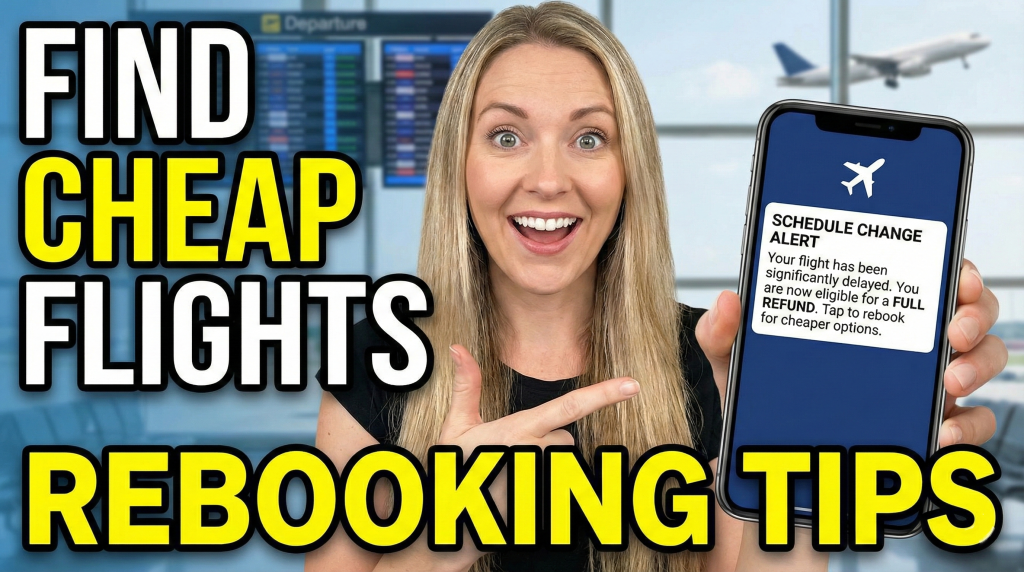
The strategic application is more interesting than it first appears. If you booked a cheap connecting flight because nonstop options were expensive, and the airline later changes your schedule significantly, you can request a refund and rebook—potentially switching to that nonstop route if prices have dropped or if you’re willing to pay the difference. Similarly, if you bought a nonrefundable ticket and your plans change, you might monitor the route for schedule changes that would entitle you to a refund rather than accepting the cancellation fee.
This isn’t about gaming the system—it’s about understanding your contractual rights when the airline alters the agreement you purchased. Airlines make schedule changes frequently as they optimize operations, and most passengers simply accept whatever new timing they’re offered. Knowing you have the option to demand a refund instead gives you leverage to either get your money back or negotiate better rebooking options.
The limitation is that this only applies to airline-initiated changes. If your schedule changes and the airline offers alternative flights that meet DOT definitions of “comparable,” you may need to explicitly request a refund rather than accepting the rebooking. The process isn’t always automatic, and some airlines initially resist refund requests for changes they consider minor. Knowing the specific thresholds defined in DOT guidance helps you assert your rights when applicable.
Group Booking and Fare Bucket Dynamics
When searching for multiple tickets simultaneously, airline systems default to showing you the price for the lowest fare bucket that has enough seats available. If there’s one seat at $200 and two at $350, a search for three tickets will show $350 per person even though that $200 seat exists. This fare bucket behavior means group bookings almost always display higher per-ticket prices than individual searches reveal.
The workaround is simple but tedious: book tickets individually rather than as a group purchase. Search for one ticket, note the price, book it. Then immediately search again for the next ticket. In the scenario above, you’d pay $200 for the first ticket, then $350 each for the remaining two, averaging $300 per person instead of $350. On a family of four, this could save $200-400 total depending on how fare buckets are distributed.
The limitation is that this only works when you’re willing to risk being separated if the cheapest seats are in different cabin sections, and when the time investment is worth the savings. For small groups (2-3 people), the savings typically justify the extra booking steps. For larger groups (8+), the complexity of managing separate reservations and the near-certainty of being scattered across the plane make group booking more practical despite the premium.
Airlines sometimes offer group fare programs for 10+ passengers that provide different pricing structures, though these typically require advance coordination and may not always beat individual booking strategies. The break-even point depends on the specific route and how tightly fare buckets are priced relative to each other.
In Short
- Fare buckets display the lowest price available for the number of seats requested—individual booking captures cheaper seats when only one or two exist per bucket
- Savings of $50-150 per person are common for groups of 3-5; larger groups face diminishing returns from complexity
- Consider whether saved money justifies separate seat assignments and reservation management
Advanced and Risky Strategies
Several unconventional booking approaches can generate savings but carry meaningful risks. Hidden city ticketing—booking a flight to a distant destination with a connection in your actual target city, then simply not boarding the final leg—exploits pricing inefficiencies where nonstop flights cost more than routes with connections. A Los Angeles-Chicago nonstop might be $350, while Los Angeles-Chicago-Detroit costs $280. If you only need to get to Chicago, booking the cheaper Detroit routing and skipping the final flight saves $70.
Airlines explicitly prohibit this practice in their contracts of carriage. Consequences for frequent violators can include account termination, confiscation of frequent flyer miles, or being billed for the fare difference. The practical risk is lower for occasional use, particularly on one-way tickets at the end of trips where there’s no return segment to be canceled. Never attempt this when checking bags—they’ll continue to the ticketed final destination—or on the outbound portion of roundtrips, as missing any segment cancels all subsequent flights.
Throwaway ticketing books a roundtrip when you only need one-way because roundtrip fares are sometimes cheaper than one-way pricing. You use the outbound flight and “throw away” the return. Airlines dislike this equally but the enforcement risk is lower since you’re not creating operational issues by disappearing mid-itinerary. The only consequence is that unused return segments don’t provide refunds or credits.
Both strategies violate airline contracts but aren’t illegal. They exist because airline pricing models create irrationalities that savvy consumers exploit. Whether using them is ethically comfortable depends on your view of contractual obligations versus market inefficiencies. They work, they save money, and they carry small but real risks of consequences if detected and used repeatedly with the same airline.
Conclusion
Finding cheap flights doesn’t require insider knowledge or complex schemes. It requires understanding how airline pricing actually functions, building flexibility into your search process, and systematically applying strategies that align your booking behavior with favorable pricing patterns. The core principles are straightforward: flexibility saves more than any other single factor, booking windows matter but specific days don’t, and complexity (multi-city routing, alternative airports, points optimization) generates savings for those willing to invest the effort.
The uncomfortable reality is that identical trips can vary by hundreds of dollars based purely on search methodology and timing decisions. Two travelers on the same flight often paid dramatically different fares—not because one got lucky but because one built flexibility into date selection, used comparison tools effectively, or understood fare bucket dynamics. These aren’t secrets; they’re publicly available patterns that most travelers either don’t know about or don’t implement systematically.
The question isn’t whether these strategies work—pricing data confirms they do. It’s whether the time investment required to implement them provides enough value relative to what you’d save. For travelers taking 3-4 trips annually, spending two hours learning search tools and monitoring prices could save $800-1,500 per year. That’s a compelling return on time. For once-every-few-years travelers, simply booking within the standard windows and using flexible dates captures most of the available savings without needing deep expertise.
Start with the highest-leverage tactics: flexible dates, comparison search tools, and booking within optimal windows. These require minimal effort and deliver the majority of possible savings. Add complexity (alternative routing, points optimization, group booking strategies) only when the incremental savings justify the additional planning. The goal isn’t perfect optimization—it’s paying reasonable prices for flights rather than whatever the algorithm decided you’d accept when you happened to search.
External Link Recommendation Table
| Anchor Text | Source | URL |
|---|---|---|
| Airline pricing regulations | U.S. Department of Transportation | https://www.transportation.gov/airconsumer/airline-pricing |
| Airline refund requirements | U.S. Department of Transportation | https://www.transportation.gov/individuals/aviation-consumer-protection/refunds |
| Flight delay and cancellation guidance | U.S. Department of Transportation | https://www.transportation.gov/individuals/aviation-consumer-protection/flight-delays-cancellations |
Where to Book
| Platform | Best For | Link |
|---|---|---|
| Google Flights | Comparing fares across airlines with flexible date and calendar search | Search Google Flights |
| Skyscanner | Aggregating budget and low-cost carrier fares often missing from other engines | Search Skyscanner |
| Expedia | Bundling flights with hotels and cars for combined trip savings | Book on Expedia |