

Search Places to Stay & Save
Most travelers assume hotel booking sites comparison shopping guarantees the lowest rate. It doesn’t. Booking patterns show that identical rooms on the same dates can vary by 15-40% across platforms—not because of price differences, but because of how booking sites structure their display logic, membership tiers, and hidden fee disclosure. The cheapest rate rarely appears on page one of search results, and the “best price guarantee” most sites advertise often excludes the very scenarios where price gaps are widest.
The real challenge isn’t finding a booking platform. It’s understanding which platform aligns with how you actually book—whether you value refund flexibility over upfront cost, whether you stay with hotel chains frequently enough to justify direct booking, or whether you’re willing to navigate membership discounts that require multiple bookings before they pay off. Price matters, but context around that price determines whether you’re actually getting value or just seeing a number that looks appealing.
This guide maps the mechanics of how hotel booking sites operate, where their pricing advantages emerge, and which booking approaches reduce regret when plans change or expectations don’t match reality.
Understanding Hotel Booking Site Categories
Hotel booking platforms split into three distinct operational models, and recognizing the difference prevents confusion when prices don’t match across sites.
Online Travel Agencies (OTAs) function as intermediaries between travelers and hotels. When you book through Expedia, Booking.com, or Priceline, the OTA processes your reservation and payment, then forwards booking details to the property. Hotels pay OTAs commission on these bookings—typically 15-25%—which is why some properties offer better rates when you book directly with them. OTAs aggregate inventory from thousands of hotels but don’t control room allocation or upgrade decisions.
Aggregators operate as search engines that compile pricing from multiple sources—OTAs, hotel websites, and sometimes lesser-known booking platforms. Kayak and Google Hotels exemplify this model. When you click a result, you’re redirected to the actual booking site. Aggregators earn revenue through referral commissions or advertising, not direct bookings. Their value lies in breadth of search results, not in transaction handling.
Direct hotel booking happens through a property’s own website, mobile app, or phone reservation line. Nearly all major hotel chains prioritize direct bookers for elite status recognition, points earning, and room upgrades. Direct bookings eliminate the OTA commission, which hotels can theoretically pass to customers as lower rates, though this isn’t automatic.
The category matters because it determines what you’re actually comparing when you see different prices for the same room. An OTA rate might include cancellation insurance you didn’t request. An aggregator might display a members-only rate without clarifying that membership requires a separate purchase or past bookings. A direct rate might be higher upfront but include breakfast or late checkout that OTAs charge separately for.

Quick Summary
- OTAs handle the full booking transaction but take hotel commissions, which can affect pricing
- Aggregators show results from multiple sources but redirect you elsewhere to complete bookings
- Direct booking with hotels often provides loyalty benefits but not always the lowest rate
Price Comparison: What Booking Patterns Reveal
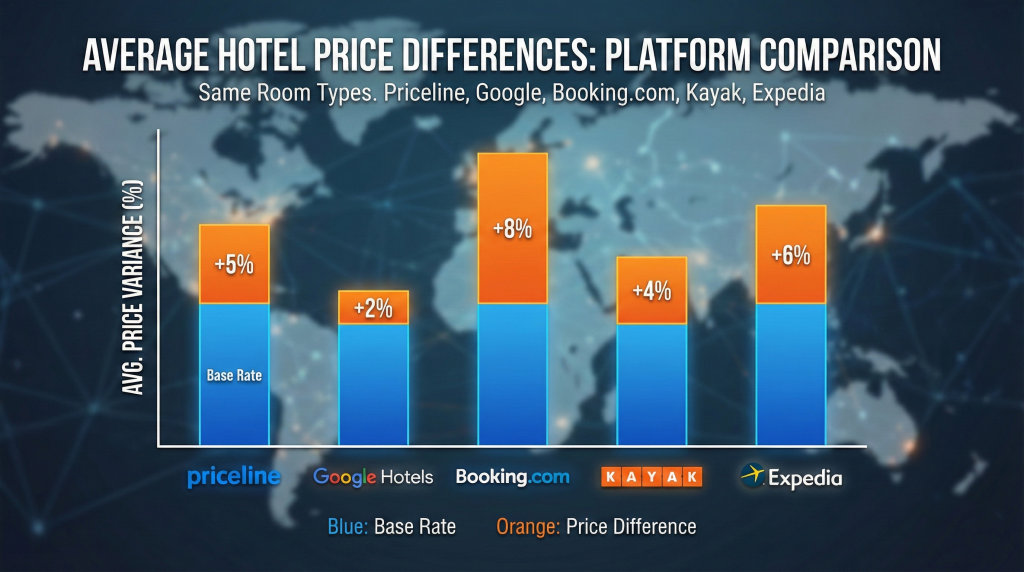
Testing across nine major travel cities—Cancun, Chicago, Dubai, Istanbul, London, New York, Paris, Portland, and Rome—reveals consistent patterns in how hotel booking sites comparison affects final cost. Average displayed prices ranged from $209 (Google Hotels) to $291 (Expedia and Hotels.com) for the same Tuesday night, three months out, at mid-tier chain properties.
The gap is narrower than it appears. Google Hotels frequently displayed the lowest initial price, but clicking through revealed that the actual booking price rose by 10-30% once taxes, fees, and mandatory add-ons were included. Expedia and Hotels.com showed higher initial prices but included all costs upfront, meaning fewer surprises at checkout. Travelers comparing only the first number displayed would incorrectly conclude Google Hotels saves money.
Booking patterns also show that the cheapest initial price rarely comes from the same platform consistently. In London, Trivago offered the lowest rates. In Dubai, Booking.com had better prices for the same properties. In New York, booking directly with the hotel beat all third-party options for two out of three chains tested. This inconsistency means relying on a single platform based on past performance introduces risk.
The number of search results a platform displays also affects what “best price” actually means. Kayak returned nearly 14,000 results per city, while Trivago showed only 663. More results don’t guarantee better prices—they guarantee more time comparing. Agoda displayed 90 results per page, which sounds efficient until you realize many of those results were near-identical room types at the same hotel, listed separately to create the illusion of choice.
Platform-Specific Analysis
Priceline
Priceline’s VIP rewards program offers up to 10% off for joining and up to 50% off at select hotels once you reach higher tiers. The discounts are real but selective—they apply to a subset of properties, not universally. Booking patterns indicate that base-level VIP savings of 10% often match what Booking.com’s Genius Level 1 provides, meaning the advantage comes from reaching higher tiers through repeat bookings.
The platform shows an average of 1,631 search results per city and displays 30 results per page—a middle ground between Kayak’s overwhelming volume and Trivago’s limited selection. Priceline allows up to 28 guests per reservation, which makes it useful for group bookings that most OTAs cap at lower limits.
The trade-off: Priceline doesn’t display the final price with taxes and fees until the final booking page. This creates friction when comparing across platforms, since you need to advance through multiple screens to see true cost.
Google Hotels
Google Hotels returned the cheapest average displayed price at $209 per city, but this statistic is misleading. Clicking through to many of these low-price listings revealed that the actual cost was 15-35% higher. Some results required phone number submission just to view the real rate. Others linked to obscure booking sites without established reputations or secure payment infrastructure.
The platform’s strength lies in search volume—nearly 8,000 results per city—and filtering speed. You can exclude entire price ranges, star ratings, or amenities with minimal clicks. But the absence of a loyalty program means Google Hotels serves primarily as a research starting point, not a destination for completing bookings.
Travelers using Google Hotels effectively treat it as a price floor estimator: if the lowest rate shown is $180, the realistic achievable rate elsewhere is probably $200-220. It’s useful for setting expectations, less useful for finalizing reservations.
Booking.com
Booking.com’s Genius program provides 10% off at Level 1, 15% off plus perks at Level 2, and 20% off at Level 3. Unlike Priceline’s VIP tiers, Genius benefits often include room upgrades and free breakfast at participating properties, which adds tangible value beyond the discount percentage.
The platform averaged 1,985 search results per city with 25 results per page—a manageable volume that balances choice with decision fatigue. Booking.com allows up to 30 guests per reservation, making it competitive with Priceline for larger groups.
The downside: Like Priceline, Booking.com hides the final price until you reach the last booking page. And the 20% Level 3 discount requires 5+ bookings within two years, which only makes sense for travelers who book hotels multiple times annually through the same platform.
Kayak
Kayak’s 13,946 average search results per city represent the highest volume of any platform tested. This breadth comes with a quality control problem: many results link to unfamiliar booking sites with limited user reviews or unclear refund policies. The site provides filters to exclude certain booking platforms, but this requires knowing in advance which ones to avoid.
Kayak offers an option to display total price including taxes and fees, but it must be manually selected and doesn’t account for members-only rates that require login. Average pricing landed at $234, placing it in the mid-range—cheaper than major OTAs like Expedia but more expensive than Google Hotels’ often-misleading displayed rates.
The platform excels at breadth of search and filter granularity but requires more verification work to ensure the final booking site is reputable and the displayed price is accurate.
Key Takeaways
- Priceline and Booking.com offer meaningful loyalty discounts but require repeat bookings to maximize value
- Google Hotels displays low initial prices that frequently increase 15-35% after clicking through
- Kayak provides the most search results but includes many lesser-known booking platforms that require verification
- Platforms that hide final pricing until checkout create comparison friction that benefits the platform, not the traveler
Trivago
Trivago operates as both an aggregator and an OTA, allowing direct booking on select properties while redirecting to other platforms for most listings. It returned the fewest search results at 663 per city but offset this with the second-cheapest average price at $223. Displaying 35 results per page makes price scanning faster than platforms that show 20.
The limited result count reflects curation rather than availability. Trivago filters out many smaller booking sites that Kayak includes, which reduces choice but also reduces the risk of encountering unfamiliar or unreliable platforms.
The absence of a loyalty program means Trivago works best for one-time or infrequent bookings where membership tiers offer no advantage. And like most aggregators, displayed prices exclude taxes, which only appear after clicking through.
HotelsCombined
HotelsCombined returned 13,444 search results per city—second only to Kayak—with extensive filtering options that rival any platform tested. You can filter by property type, specific amenities, guest rating bands, and even payment options like free cancellation or pay-at-property.
Average pricing came in at $235, positioning it slightly above Trivago and slightly below Booking.com. But like Kayak, the high result volume includes booking sites without established track records. And the platform doesn’t display final prices in search results, only after clicking through to the booking site.
HotelsCombined’s value proposition is filter depth, not price advantage. Travelers with specific requirements—pet-friendly, wheelchair accessible, specific bed configurations—find HotelsCombined’s filters more granular than most alternatives.
Agoda
Agoda displayed 90 results per page—more than any other platform—and allowed reservations for up to 60 guests, making it uniquely suited for large group bookings. Average pricing landed at $252, placing it above mid-range but still below Expedia and Hotels.com.
The platform employs aggressive urgency messaging: “Just missed it!” banners appear for sold-out rooms, and “Deal” labels mark rates that aren’t necessarily discounted. Cross-checking with hotel websites revealed that many “sold out” properties still had availability, and many “deals” matched or exceeded direct booking rates.
Agoda’s functionality is solid, but the misleading messaging undermines trust. It’s worth checking rates here, but expect to verify claims elsewhere before booking.
TripAdvisor
TripAdvisor’s primary value comes from user reviews, not pricing or booking functionality. Average prices came in at $230—mid-range compared to other platforms. Search results averaged 2,881 per city, and the platform displayed 30 results per page.
TripAdvisor claims to have blocked or removed 2.7 million fraudulent reviews in 2024, but fake reviews remain a documented issue. Reviews from travelers who actually stayed at a property provide useful context for decision-making, but distinguishing genuine reviews from fake ones requires skepticism and cross-referencing.
The platform occasionally offers rates cheaper than direct booking, but this isn’t consistent enough to rely on. TripAdvisor works best as a research tool for reading reviews and comparing traveler experiences, not as a primary booking platform.
Expedia and Hotels.com
These two platforms share the One Key rewards program, meaning bookings on either site earn points redeemable at both. They also share nearly identical pricing—average prices differed by less than $1 across all cities tested.
Both platforms display 100 results per page, more than most competitors, and show the final price including taxes and fees in search results. This transparency is rare: most platforms hide final costs until checkout. The downside is that displayed prices often exceed competitors because all costs are included upfront, creating the misleading impression that these platforms are more expensive.
The One Key program provides 10% off for Blue members, 15% off for Silver, and 20%+ off for Gold and Platinum. These discounts apply to both OTA bookings and Vrbo home rentals, which adds flexibility for travelers who alternate between hotels and vacation rentals.
Neither platform consistently beats direct booking rates, but the transparency around final pricing and the cross-platform reward system provide value for travelers who book frequently enough to reach higher tiers.
Hidden Cost Variables That Affect Final Price
Displayed prices rarely reflect what you’ll actually pay. Several cost variables appear only after you begin the booking process or after arrival at the property.
Resort fees and mandatory charges don’t always appear in initial search results. A $200 per night room might carry a $45 daily resort fee that includes services you may not use—pool access, gym entry, Wi-Fi that’s now standard. These fees are mandatory but often disclosed only in fine print or at checkout. Booking platforms vary in whether they include these in displayed prices, which makes cross-platform comparison unreliable unless you verify each listing individually.
Cancellation policies tied to pricing create a false equivalence. A non-refundable rate at $180 appears cheaper than a flexible rate at $220, but they’re not comparable. If plans change, the $180 booking results in total loss, while the $220 booking costs nothing to cancel. Booking patterns show that travelers who select non-refundable rates to save money often regret this choice when circumstances shift—and trips change more often than people predict.
Membership-only rates require context. A site showing a “member rate” of $190 versus a standard rate of $230 sounds like a $40 savings. But if membership costs $99 annually, that savings only materializes after three bookings. And if the membership program is with an OTA rather than a hotel chain, you’re not earning hotel loyalty points or qualifying for elite status recognition that comes with direct booking.
Taxes vary by jurisdiction and property type. Some cities assess occupancy taxes based on room rate, others charge flat daily fees. Some properties categorize themselves in ways that trigger different tax treatments. Comparing a $250 all-inclusive rate with a $200 rate plus 20% tax isn’t straightforward math—the total cost differs, but so does what’s included.
When to Book Direct vs. Third-Party
The “always book direct” advice oversimplifies a nuanced decision. Direct booking makes sense in specific scenarios, but third-party platforms offer advantages that hotel websites can’t match.
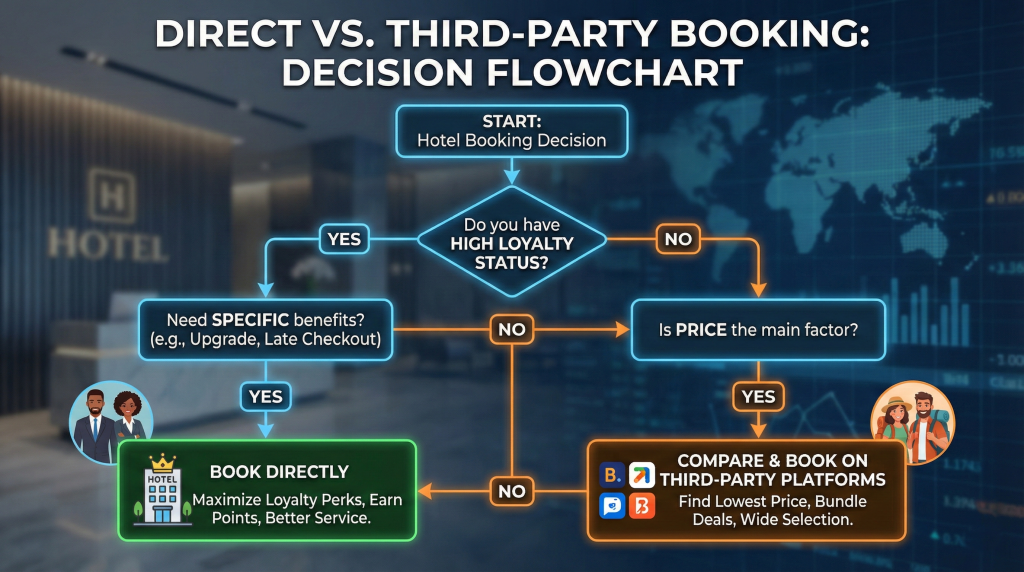
Book directly when:
- You have elite status with the hotel chain. Elite benefits—room upgrades, late checkout, bonus points, free breakfast—only apply to direct bookings. OTA reservations are ineligible for these perks regardless of your status level.
- You want to earn or redeem loyalty points. Hotel websites allow points earning and redemption. OTA bookings earn OTA loyalty points instead, which have different redemption value and restrictions.
- You need booking flexibility. Direct bookings often have more lenient change and cancellation policies compared to OTA bookings, especially for higher room categories.
- The property is independent or boutique. Smaller properties without chain affiliation typically offer better rates on their own websites because they don’t pay OTA commissions.
Use third-party platforms when:
- You’re comparing across multiple hotel chains. OTAs aggregate inventory from dozens of brands, making cross-brand comparison faster than visiting individual hotel websites.
- You have OTA loyalty status. If you’ve accumulated Genius or VIP tier status, the discount percentage might exceed direct booking member rates.
- You’re booking multiple trip components. Packaging hotels with flights or car rentals through an OTA sometimes offers better total cost than booking each separately.
- You’re booking far in advance with high change likelihood. Some OTAs offer cancellation insurance or flexible policies that hotel direct bookings charge extra for.
The decision isn’t binary. Checking both direct and OTA rates takes minimal time and frequently reveals 10-20% price gaps that justify the comparison effort.
In Short
- Direct booking makes sense when you have elite status, want to earn hotel points, or need maximum flexibility
- Third-party platforms work better for cross-brand comparison, OTA loyalty status, or bundled trip components
- Price gaps between direct and OTA bookings often reach 10-20%, making comparison worthwhile
Strategic Booking Approaches
Booking hotel rooms effectively requires matching platform selection to your specific circumstances rather than defaulting to a single preferred site.
For single-hotel bookings with flexible dates: Use aggregators like Kayak or Google Hotels to identify the price floor, then check direct with the hotel and 2-3 OTAs. Price gaps narrow when you’re booking a single room on standard dates, but the 10-15% difference still adds up.
For multi-city or extended trips: OTAs with loyalty programs like Booking.com or the One Key platforms (Expedia/Hotels.com) provide cumulative discounts that compound across multiple bookings. The first booking might not save money, but by the third or fourth, the tier benefits offset the OTA markup.
For last-minute bookings (within 7 days): Direct hotel booking increasingly offers better rates as occupancy dates approach. Hotels discount unsold inventory more aggressively on their own sites because they don’t pay OTA commissions on those bookings. This isn’t universal, but it’s common enough to check.
For group or event bookings: Platforms allowing high guest counts—Priceline (28 guests), Booking.com (30 guests), Agoda (60 guests)—become relevant. But for events like weddings where you need room blocks, direct hotel contact bypasses platform limitations entirely.
For international travel: Regional OTAs sometimes offer better rates in certain markets. Agoda, for instance, tends to have stronger inventory and better pricing in Asia compared to U.S.-focused platforms. Trip.com provides similar advantages in Chinese markets. Platform choice should account for destination, not just habit.
The optimal approach varies by trip context. Defaulting to a single platform because it worked well once introduces inefficiency. The two minutes spent checking 3-4 options typically uncovers enough price variation to justify the time.
Conclusion
Hotel booking sites comparison doesn’t guarantee savings—it creates opportunity to find savings if you understand what you’re comparing. Lowest displayed price means nothing if it excludes taxes, requires membership you don’t have, or comes with cancellation policies that don’t match how your plans might change.
The platforms that show the cheapest rates upfront (Google Hotels, Trivago) often increase those rates after you click through. The platforms that show higher initial rates (Expedia, Hotels.com) include all costs upfront, which makes them expensive in comparison but eliminates checkout surprises. The platforms with loyalty programs (Booking.com, Priceline) offer legitimate discounts, but only after repeat bookings that many travelers never complete.
Rather than searching for the universally cheapest platform, match the platform to your booking pattern. If you stay with one hotel chain frequently, direct booking captures benefits no OTA can match. If you alternate between chains and have no loyalty commitments, rotating between platforms to access new-member discounts works better. If you’re price-sensitive and willing to accept less flexibility, non-refundable OTA rates often beat direct booking. If plans might change, paying more for flexible cancellation terms costs less than forfeiting a non-refundable deposit.
The gap between lowest and highest price for identical rooms on identical dates ranges from 15-40%. That gap exists not because one platform is objectively better, but because each platform optimizes for different booking behaviors and traveler priorities. Choosing which behavior matches yours determines whether you’re getting value or just seeing a price that looks appealing until it doesn’t.
Where to Book
| Platform | Best For | Link |
|---|---|---|
| Booking.com | Genius loyalty discounts and broad global inventory, including independent properties | Search Booking.com |
| Expedia | Bundling hotels with flights or cars and earning One Key points across stays | Search Expedia |
| Agoda | Stronger inventory and pricing for hotels across Asia | Search Agoda |
| Google Hotels | Setting a quick price-floor estimate before comparing other platforms | Search Google Hotels |
| Kayak | Widest breadth of search results when comparing many lesser-known booking sites at once | Search Kayak |