

Search Places to Stay & Save
For over a decade, travelers operated under a relatively simple lodging paradigm. Vacation rentals offered space, local authenticity, and cost savings for groups, while hotels provided standardized service, predictable amenities, and convenience for shorter stays. However, structural shifts in the travel industry have dismantled these clean distinctions. Rising platform fees, professionalized property management, municipal regulatory crackdowns, and hotel dynamic pricing algorithms have converged to create a far more complex decision matrix.
Today, selecting the optimal lodging model is no longer about finding the cheapest option or assuming one category inherently outperforms the other. It requires a systematic assessment of total cost realities, operational reliability, regulatory compliance, and individual trip requirements. Travelers frequently report frustration when unexpected cleaning checklists, punitive cancellation policies, or hidden destination fees disrupt their travel budgets and expectations. This guide provides a comprehensive, data-driven analysis of the structural differences between vacation rentals and hotels to enable objective, low-regret booking decisions.
1. The Evolution of Lodging Economics: Beyond the Base Rate
To understand the true cost of accommodation, one must examine how the underlying business models have evolved. Historically, vacation rentals were peer-to-peer arrangements managed by individual property owners. These listings typically featured low overhead costs, allowing owners to offer competitive nightly rates. However, the professionalization of the short-term rental market has introduced institutional property management firms, dynamic pricing software, and multi-layered fee structures designed to maximize yield per unit.
According to consumer expenditure patterns and lodging industry reports, the initial price displayed on search results pages rarely reflects the final checkout cost. This discrepancy is particularly pronounced in the vacation rental sector, where platform-level service charges, cleaning fees, and local occupancy taxes are added incrementally during the checkout flow. Conversely, hotel pricing has also shifted toward unbundled models, introducing mandatory urban destination surcharges and amenity fees that mimic the platform fees of short-term rentals.
Consequently, the economic comparison between these two models must be calculated using the Total Cost of Occupancy (TCO). This metric aggregates the base nightly rate, mandatory platform or property fees, localized tax burdens, incidental hold requirements, and indirect costs such as dining, laundry, and transportation. Without this comprehensive calculations, travelers risk selecting an option that appears economical on paper but carries a premium in execution.
Key Takeaways
- The professionalization of short-term rentals has introduced dynamic pricing and complex fee layers that mirror hotel yield management.
- Comparing base nightly rates is an unreliable methodology; travelers must calculate the total cost of occupancy (TCO) including all transaction fees.
- Both lodging sectors are experiencing cost convergence, with hotels adding destination fees and rentals adding operational surcharges.
2. The Anatomy of Hidden Fees in Vacation Rentals
The primary source of consumer friction in the vacation rental ecosystem is the accumulation of post-search fees. While a hotel room rate is generally subject to standard state and local lodging taxes, a vacation rental invoice often contains four distinct cost categories that significantly inflate the final transaction value.
First, the cleaning fee is set independently by the property host or management company. Originally intended to cover the cost of turnover between guests, this fee has increasingly become a mechanism for hosts to subsidize lower base nightly rates. Because cleaning fees are flat charges, they disproportionately impact short stays. A $150 cleaning fee applied to a two-night stay adds $75 to the effective nightly rate, whereas the same fee spread over a ten-night stay adds only $15 per night.
Second, platform service fees are levied by the hosting marketplace to cover payment processing, customer support, and digital infrastructure. These fees typically range from 12% to 17% of the booking subtotal (the base rate plus the cleaning fee), compounding the impact of high turnover charges.
Third, localized occupancy taxes and tourism assessments are mandated by municipal governments. While these taxes apply to both hotels and rentals, short-term rentals are sometimes subject to additional localized administrative fees or higher tax brackets designed to mitigate the impact of tourism on local housing markets. Finally, some properties impose secondary guest fees, charging a premium for every individual beyond a baseline occupancy threshold, regardless of the property’s physical capacity.
Bottom Line
- Cleaning fees are flat-rate charges that penalize short-duration bookings and favor longer stays.
- Platform-level service fees compound on top of cleaning fees, driving a significant wedge between the advertised rate and the checkout price.
- Extra-guest surcharges can silently double the cost of a multi-person booking if not analyzed prior to reservation.
3. Hotel Pricing Transparency and Surcharges
While hotels are frequently positioned as the more transparent alternative, they are not immune to deceptive pricing practices. The widespread adoption of resort fees, urban destination fees, and facility surcharges has drawn scrutiny from regulatory bodies, including the Federal Trade Commission guidelines on fee transparency. These mandatory daily charges are ostensibly positioned as bundled packages covering amenities such as fitness center access, high-speed internet, bottled water, or local phone calls. In practice, however, they are non-negotiable fees that allow hotels to advertise artificially lower base rates on third-party distribution channels.
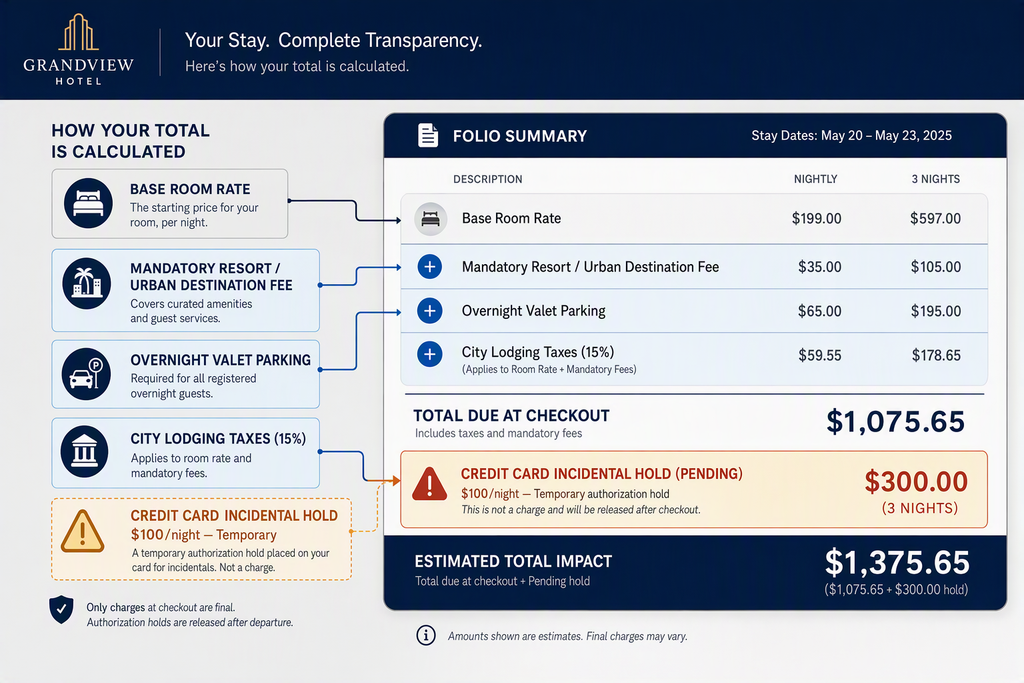
Beyond mandatory facility fees, hotels impose secondary costs that can quickly erode a travel budget. Valet and self-parking charges in metropolitan centers routinely exceed $50 to $80 per night, often accompanied by city parking taxes. Furthermore, ancillary services such as laundry, early check-in, late checkout, and in-room dining carry high markups. Travelers must also account for credit card incidental holds. While not an outright charge, hotels typically authorize a temporary hold of $50 to $200 per night for incidentals, which can temporarily restrict a traveler’s available credit or liquidity during their trip.
Quick Summary
- Hotel resort fees are mandatory daily surcharges that must be added manually to compare costs accurately.
- Metropolitan parking charges and premium incidental holds represent substantial cash-flow considerations for hotel guests.
- Ancillary costs like high-priced laundry and dining can offset any initial savings achieved on the base room rate.
4. Comparative Cost Modeling: Real-World Scenarios
To demonstrate the practical application of the Total Cost of Occupancy (TCO) framework, let us analyze three distinct travel cohorts. These scenarios illustrate how variables such as travel duration, group size, and dining habits shift the financial balance between vacation rentals and hotels.
Consider Scenario A: A solo business traveler executing a three-night stay in a primary metropolitan market. The hotel option features a base rate of $200 per night, an urban destination fee of $25 per night, and a local lodging tax of 15%. The vacation rental alternative offers a comparable private studio apartment at a base rate of $160 per night, but carries a $120 cleaning fee, a 14% platform service fee, and the same 15% local tax. When calculated over three nights, the hotel TCO totals $776.25, while the vacation rental TCO reaches $779.70. Despite the rental’s lower base rate, the front-loaded cleaning fee and platform surcharge eliminate any economic advantage, rendering the hotel the more cost-effective and operationally convenient choice.
Scenario B involves a family of four (two adults, two children) traveling for seven nights. A standard hotel room requires booking either two adjoining rooms or a premium suite to accommodate the family comfortably, resulting in a base rate of $350 per night. Alternatively, a two-bedroom vacation rental is available for $280 per night, featuring a full kitchen, laundry facilities, a $150 cleaning fee, and a 14% platform fee. For a seven-night stay, the rental’s kitchen facilities allow the family to prepare breakfast and lunch at home, saving an estimated $100 per day in restaurant expenditures. The final lodging TCO for the rental is $2,746, compared to the hotel’s lodging-only cost of $2,817. When factored alongside the $700 in dining savings, the vacation rental yields significant total trip cost optimization.
Scenario C examines a multi-generational group of eight adults traveling for five nights for a family gathering. Booking four separate hotel rooms at $180 per night results in a baseline lodging cost of $7,200 (excluding taxes). A large, five-bedroom vacation rental with communal living spaces, a private pool, and outdoor dining facilities is priced at $750 per night, with a $350 cleaning fee and a 14% platform service fee. The vacation rental TCO is approximately $5,310, offering a direct financial saving of nearly 26% while providing private gathering spaces that a hotel environment cannot replicate without expensive banquet room rentals.
Key Takeaways
- Short-duration solo trips almost universally favor hotels due to the absence of flat-rate cleaning fees.
- Extended family travel yields substantial compound savings in vacation rentals via kitchen access and group consolidation.
- Large group travel of six or more individuals achieves maximum cost optimization by sharing a single high-capacity rental property.
| Travel Scenario | Hotel TCO (Est.) | Vacation Rental TCO (Est.) | Primary Financial Driver |
|---|---|---|---|
| Solo Business (3 Nights) | $776.25 | $779.70 | Flat cleaning fee amortization |
| Family of Four (7 Nights) | $2,817.00 | $2,746.00 (plus dining savings) | Kitchen utility & space requirements |
| Group of Eight (5 Nights) | $7,200.00 | $5,310.00 | Room consolidation efficiency |
5. Amenity Gaps and Operational Realities
The financial math of lodging is heavily influenced by the utility of on-site amenities. The presence or absence of specific facilities can shift secondary trip expenses dramatically. The most critical amenity gap is the kitchen. Vacation rentals typically offer fully equipped kitchens, allowing travelers to store groceries, prepare meals, and avoid the high tax-and-tip burden of restaurant dining. For families, budget travelers, or those with dietary restrictions, this utility is a major cost-mitigation tool.
However, hotels counter this advantage with operational predictability and services that reduce labor for the traveler. Daily housekeeping, on-site fitness centers, concierge services, and 24-hour front desk operations provide a level of convenience that vacation rentals rarely match. In a vacation rental, guests are often expected to perform basic property maintenance, such as taking out trash, stripping linens, and running the dishwasher before departure—frequently despite paying a premium cleaning fee. This “chore list” phenomenon has become a point of significant friction for travelers who feel they are paying for professional cleaning services while being forced to perform manual labor.
Furthermore, physical security and safety standards can vary widely. Hotels operate under strict commercial fire safety regulations, including centralized sprinkler systems, clearly marked evacuation routes, professional security personnel, and electronic keycard access systems. Vacation rentals, operating within residential zones, are subject to local residential building codes which may not be as rigorously enforced or standardized. The reliance on key lockboxes or smart locks in residential neighborhoods can also present check-in challenges, particularly during late-night arrivals or in areas with poor cellular connectivity.
In Short
- Kitchen and laundry facilities in vacation rentals serve as powerful secondary cost-saving mechanisms for long stays.
- Hotel services reduce guest labor, eliminating check-out chore lists and providing consistent daily maintenance.
- Commercial safety and physical security protocols remain a structural advantage of traditional hotel properties.
6. Cancellation Flexibility and Consumer Protection Policies
In an era of volatile airline scheduling and unpredictable global travel disruptions, cancellation flexibility has become a critical variable in lodging selection. The two models operate under fundamentally different consumer protection frameworks, with distinct implications for financial risk management.
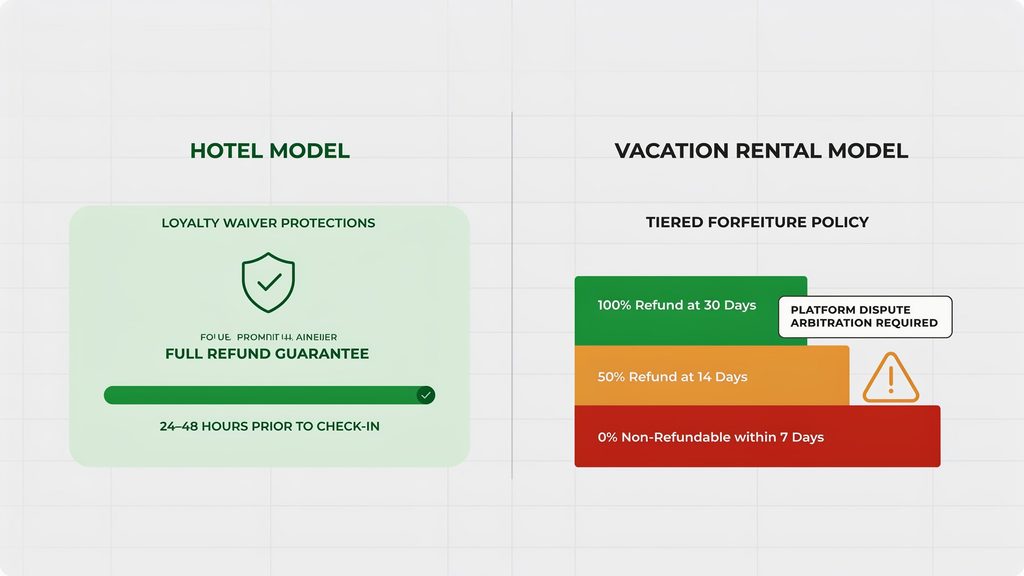
Hotels generally offer highly flexible cancellation terms, particularly when booked directly through corporate channels. Many standard hotel rates allow penalty-free cancellations up to 24 to 48 hours prior to the scheduled arrival time. This flexibility is supported by sophisticated global inventory systems that can easily reallocate rooms to last-minute travelers. Furthermore, hotel loyalty programs frequently waive cancellation penalties entirely for elite tier members, providing an additional layer of financial protection.
Vacation rentals, by contrast, utilize highly rigid, host-selected cancellation tiers. These policies range from “flexible” (full refund up to 14 days before arrival) to “strict” (50% refund up to 30 days before arrival, with zero refund thereafter). Because each vacation rental is a unique, single-unit inventory item, hosts are highly vulnerable to the financial loss of late-stage cancellations, as re-booking the property on short notice is statistically difficult. When disputes arise over cancellations due to medical emergencies, flight cancellations, or severe weather, travelers booking vacation rentals are dependent on platform-level arbitration policies. These policies often require extensive documentation and may not cover scenarios that traditional travel insurance or hotel customer service agents would resolve immediately with a credit or waiver.
Bottom Line
- Hotels offer superior short-notice cancellation windows, reducing financial risk from travel itinerary disruptions.
- Vacation rental cancellation policies are rigid, reflecting the high financial risk of single-unit inventory management.
- Platform arbitration processes require rigorous documentation and offer less discretionary leniency than corporate hotels.
7. The Local Impact and Regulatory Landscape
The rise of short-term rentals has transformed residential housing dynamics globally, prompting municipal governments to implement aggressive regulatory frameworks. Understanding these regulations is not merely an ethical consideration; it is a practical necessity for travelers who wish to avoid sudden booking cancellations or illegal lodging situations.
Many major metropolitan areas and popular tourist destinations have enacted strict zoning laws, caps on rental licenses, or outright bans on unhosted short-term rentals. These regulations are designed to curb housing cost inflation and protect local community structures from the pressures of commercial tourism. In cities with active enforcement regimes, unauthorized vacation rentals can be shut down by local authorities with little notice, leaving travelers stranded without accommodation. Conversely, hotels operate within dedicated commercial zones, fully licensed and integrated into local municipal planning, ensuring absolute regulatory stability.
Local Food Tip Many Tourists Miss
To experience authentic local cuisine at a fraction of tourist-zone prices, look for residential neighborhoods located just outside the commercial hotel or rental districts. Many cities feature small, family-run neighborhood establishments that serve daily fixed-price menus (often called a menu del dia or plate of the day). These dining spots cater to local workers rather than tourists, offering high-quality, culturally authentic meals without the premium pricing found on main tourist corridors.
8. Operational Failure Modes: What Happens When Things Go Wrong?
Every lodging option carries a risk of operational failure. The critical difference lies in the recovery pathways and resources available to resolve the issue. When a system failure occurs in a hotel—such as an air conditioning malfunction, a plumbing leak, or an overbooking error—the property has built-in redundancies. The front desk can typically reassign the guest to an equivalent room, upgrade them to a suite, or utilize corporate partnerships to “walk” the guest to a comparable nearby hotel at no additional cost. On-site maintenance staff are on duty to handle physical emergencies immediately.
In a vacation rental, there is zero inventory redundancy. If a major appliance fails, the water heater breaks, or the lockbox malfunctions, the guest is entirely dependent on the responsiveness of an individual host or a third-party property manager. Resolutions can take hours or even days, often requiring the guest to wait for local utility technicians. In extreme cases of host cancellations—where a host cancels a reservation last minute due to property damage or double-booking—the platform’s support system is designed to provide refunds or assist in finding alternative lodging. However, during peak travel seasons or major events, finding alternative, reasonably priced accommodation on short notice can be virtually impossible, forcing travelers to accept inferior properties or pay exorbitant premiums.
Additionally, travelers must navigate the risk of listing discrepancies or outright misrepresentation. While hotels maintain standard room photos that generally align with reality, vacation rentals are occasionally subject to stylized photography, strategic wide-angle lenses, or outdated images that mask wear, noise levels, or safety issues. This variance requires travelers to spend significant time analyzing public review trends and category-level sentiment before finalizing a booking.
Quick Summary
- Hotels feature structural redundancies, allowing rapid room reassignments during maintenance emergencies.
- Vacation rentals lack inventory backups, leaving guests vulnerable to protracted resolution times during utility failures.
- Last-minute host cancellations represent a low-probability, high-impact risk that can derail peak-season itineraries.
9. Definitive Decision Matrix: Match Your Trip to the Right Model
To synthesize these diverse analytical factors, travelers should apply a structured decision matrix based on the specific parameters of each trip. Rather than relying on default preferences, lodging selection should be treated as a variable decision optimized for group composition, stay duration, and operational requirements.
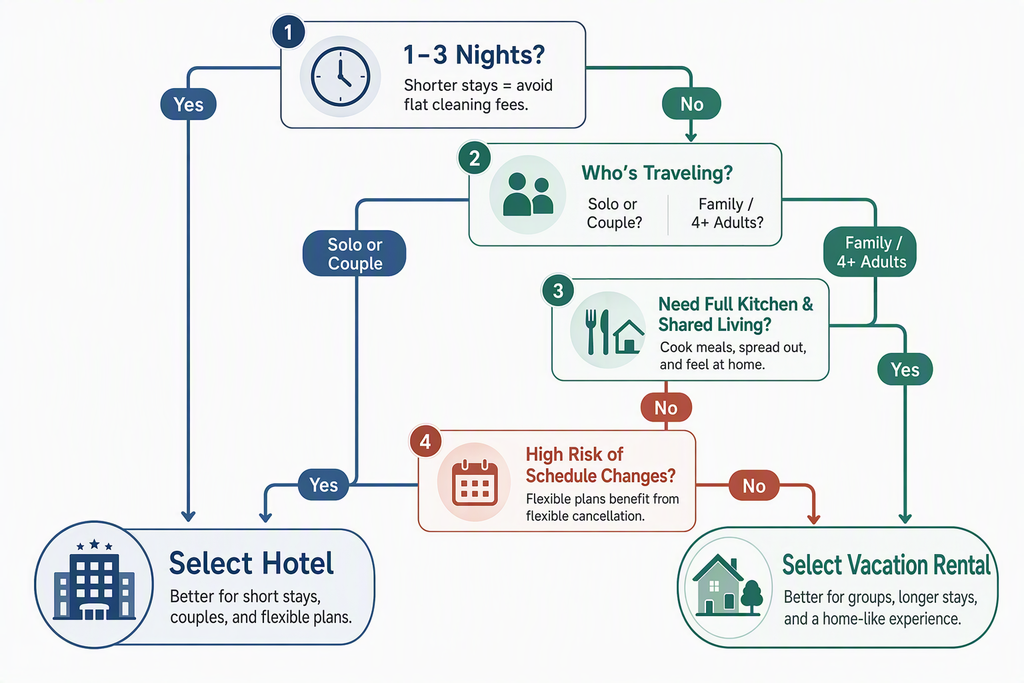
Choose a hotel when your itinerary is short (one to three nights), where arrival times are unpredictable, or when you are traveling solo or on business. The operational efficiency, reliable Wi-Fi, seamless check-in, and flexible cancellation policies align perfectly with the needs of high-efficiency, low-friction travel. Hotels are also the logical choice in destinations with volatile short-term rental regulations, ensuring your reservation remains secure and legally compliant.
Choose a vacation rental when your trip extends beyond four nights, involves a cohesive group or family requiring multiple bedrooms, or when you intend to utilize kitchen facilities to mitigate high restaurant costs. The physical space, laundry access, and communal gathering areas provide a level of comfort and psychological ease that multiple separate hotel rooms cannot match. To execute this model successfully, travelers must carefully audit the total cost structure at checkout, verify local regulatory compliance, and budget time for basic household chores and communication with property hosts.
By prioritizing objective cost calculations and operational realities over marketing narratives, travelers can confidently navigate the modern lodging landscape, protecting both their travel capital and their peace of mind.