
Search Places to Stay & Save
The traditional approach to booking travel often treats reservation confirmations as simple, low-risk administrative steps. Many travelers view the phrase “free cancellation” as an absolute safeguard, assuming that any changes to their plans will result in a clean, immediate return of their capital. In reality, the logistics behind hotel room inventory allocation make late cancellations highly costly for operators. This friction has led to increasingly complex, aggressive policy enforcement across the global lodging industry. Modern booking platforms and hotel brands use sophisticated revenue management algorithms that penalize late changes, capitalize on non-refundable rate discounts, and construct multi-layered terms of service that can catch even experienced travelers off guard.
Understanding the actual mechanics of hotel cancellation and refund policies requires looking past promotional headlines. It demands a systematic breakdown of how cancellation windows are calculated, the structural differences between direct and third-party bookings, and the legal and financial mechanisms available when disputes arise. By treating hotel reservations as legally binding options contracts, travelers can make analytical, value-based decisions that balance structural flexibility against total trip cost reality.
The Financial Mechanics of Hotel Cancellations
To understand why hotel cancellation policies are structured so rigidly, one must first understand the financial concept of perishable inventory. A hotel room is the ultimate perishable asset; if a room remains unoccupied for a single night, that specific revenue window is permanently lost. Unlike physical retail goods, hotel nights cannot be stored in a warehouse and sold later. Consequently, hotels use pricing strategies designed to secure guaranteed revenue as early as possible.
This dynamic is most clearly visible in the price spread between refundable and non-refundable rates. Non-refundable rates typically offer a discount of 10% to 20% off the standard flexible rate. In exchange for this discount, the traveler yields all cancellation rights. From the hotel’s perspective, this discount represents the price of financial certainty. By securing a non-refundable booking, the hotel guarantees its occupancy metrics and locks in cash flow, shifting the entire risk of travel disruption onto the consumer. Conversely, a refundable rate is essentially a bundled option contract. The premium paid above the base non-refundable rate is the fee the traveler pays for the option to cancel the contract up to a specified deadline.
Between these two extremes lie semi-refundable rates, which have grown increasingly common. These hybrid policies often require a non-refundable deposit—typically equivalent to the first night of the stay—while allowing the remaining balance to be cancelled without further penalty up to a certain date. In other scenarios, the policy may offer a tiered refund scale: a 100% refund if cancelled 14 days in advance, a 50% refund if cancelled 7 days in advance, and zero refund thereafter. Analyzing these trade-offs is critical when projecting total trip cost logic, as selecting a non-refundable rate to save upfront capital can easily backfire if any element of the travel itinerary remains volatile.
Another area of frequent misunderstanding is the difference between credit card pre-authorizations and actual deposit charges. When a traveler books a “refundable” room that does not require an immediate deposit, the hotel will frequently place a temporary pre-authorization hold on the credit card a few days prior to arrival. While this is not an actual charge, it does temporarily reduce the traveler’s available credit limit. If the reservation is subsequently cancelled within the allowed window, the hold is released, but the process can take anywhere from three to ten business days depending on bank processing schedules. If a traveler uses a debit card for such bookings, these pre-authorization holds directly lock up actual cash reserves, creating temporary liquidity issues that can disrupt other aspects of a trip.
Quick Summary
- Non-refundable rates offer 10% to 20% discounts because they shift all disruption risk from the hotel operator to the traveler.
- Semi-refundable and tiered cancellation rates act as hybrid models, securing partial hotel revenue while offering limited traveler flexibility.
- Pre-authorization holds on credit or debit cards can temporarily lock up travel capital for days even on fully refundable bookings.
Navigating Platform Discrepancies: OTAs vs. Direct Bookings
One of the most complex friction points in travel planning is the operational divide between booking directly with a hotel and booking through an Online Travel Agency (OTA). While both channels may list identical rooms and outwardly similar cancellation policies, the underlying contractual structures and customer service pathways are fundamentally different.
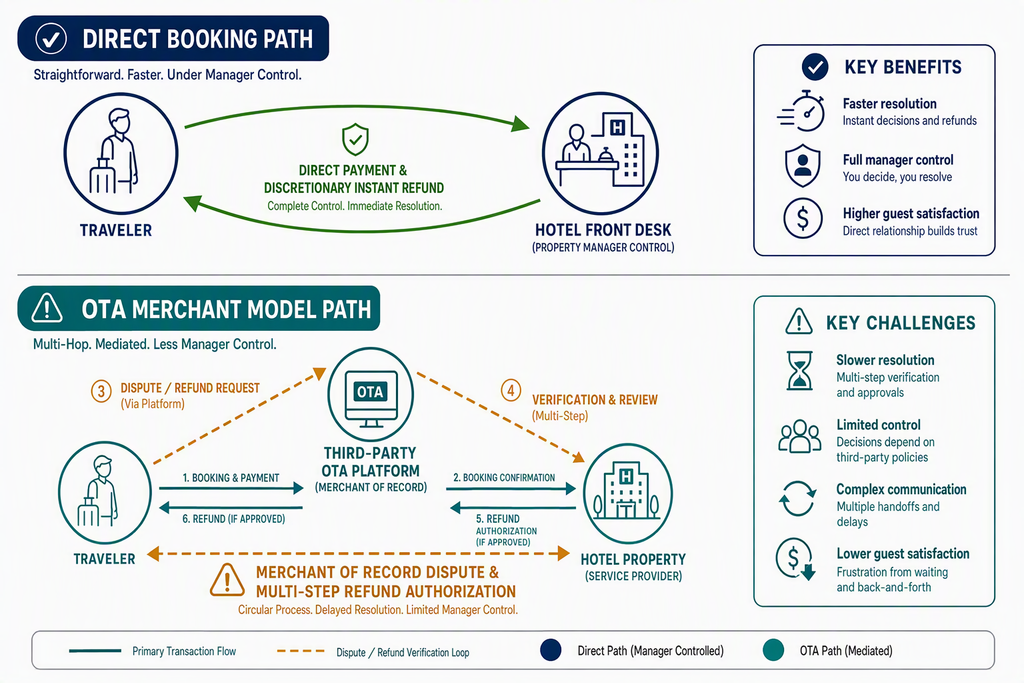
When booking through an OTA, the reservation is processed under one of two operational models: the Merchant Model or the Agency Model. Under the Merchant Model, the OTA acts as the merchant of record. The traveler pays the OTA directly at the time of booking, and the OTA subsequently pays the hotel a pre-negotiated wholesale rate. Under the Agency Model, the OTA simply facilitates the booking, but the traveler pays the hotel directly upon arrival or checkout. This distinction is critical when attempting to secure a refund. If a reservation booked under the Merchant Model must be cancelled, the hotel itself cannot process a refund because it does not hold the traveler’s money; the refund must be initiated, approved, and executed by the third-party OTA.
This structural arrangement frequently leads to customer service circularity. When a traveler contacts a hotel to request a cancellation or refund due to extenuating circumstances, the hotel staff may agree to waive the fee but state that they cannot issue the credit. The traveler must then contact the OTA, whose support staff may refuse to process the refund until they receive formal, written verification from the hotel management. This multi-step verification loop can delay refund processing for weeks and, in worst-case scenarios, result in a complete denial of the refund if the communication chain breaks down.
Conversely, direct bookings establish a direct contract between the consumer and the lodging property. Because there is no intermediary holding a commission or controlling the payment ledger, hotel general managers possess complete discretion to waive cancellation fees, modify stay dates, or issue future stay credits. For travelers who value agility and direct accountability, booking directly with the hotel chain or independent property remains the most reliable method for mitigating cancellation risks. Furthermore, direct bookings are governed by the hotel’s own brand standards, which are often more lenient and consistently applied than the third-party terms enforced by OTA algorithms.
Key Takeaways
- OTA bookings place a third-party intermediary between the traveler’s capital and the actual service provider, creating complex refund loops.
- The Merchant Model requires the OTA to initiate refunds, while the Agency Model leaves payment processing in the hands of the hotel.
- Direct bookings grant hotel property managers full discretion to resolve cancellation disputes and alter reservations without third-party approval.
| Booking Channel | Payment Holder | Discretionary Authority | Refund Processing Route |
|---|---|---|---|
| Direct Hotel Booking | The Hotel Property | High (General Manager discretion) | Directly back to original payment method |
| OTA Merchant Model | The Third-Party Platform | Low (Subject to platform-hotel contract) | Initiated by OTA after hotel verification |
| OTA Agency Model | The Hotel Property | Medium (Facilitated by platform terms) | Processed by hotel, reported to OTA |
Local Food Tip Many Tourists Miss
In highly competitive culinary markets like Tokyo, Paris, or New York, high-end independent restaurants often use strict credit card deposit and cancellation systems that mirror hotel policies. Travelers frequently plan these dining experiences around their lodging locations, but fail to realize that cancelling a restaurant reservation less than 48 hours in advance can incur non-refundable fees equal to the full cost of the tasting menu. When booking boutique accommodations, it is highly practical to audit local dining cancellation windows simultaneously to avoid compounding financial penalties if travel dates must change.
The Anatomy of Cancellation Windows
To avoid unexpected penalties, travelers must understand how hotels define and calculate their cancellation windows. A standard policy might state that free cancellation is available “up to 24 hours prior to arrival.” However, the definition of “arrival” is rarely uniform. In almost all corporate hotel policies, arrival is defined as the hotel’s standard check-in time—typically 3:00 PM or 4:00 PM—rather than the individual traveler’s expected arrival time or the calendar day itself.
This distinction is crucial when crossing time zones. A traveler located in San Francisco booking a hotel in London must calculate the cancellation deadline based on London local time. If the London hotel has a 24-hour cancellation policy with a standard 3:00 PM check-in time, the cancellation must be executed before 3:00 PM London time on the preceding day. For the traveler in San Francisco, this means the cancellation must actually be finalized by 7:00 AM Pacific Time. Failing to account for these temporal shifts is one of the most common administrative errors leading to forfeited deposits.
Furthermore, standard cancellation windows are frequently overridden by special event clauses, seasonal demand shifts, or holiday blackout dates. During periods of peak demand—such as major city-wide conventions, sporting events, or regional holidays—hotels routinely alter their cancellation terms from a standard 24-hour window to a 7-day, 14-day, or completely non-refundable requirement. These overrides are buried deep within the terms and conditions during the checkout process. Travelers who book these dates assuming standard brand-wide policies apply often discover too late that their reservations are entirely locked in. It is critical to carefully review the specific terms of the individual reservation rather than relying on general brand reputation or historical booking experiences.
In Short
- Cancellation deadlines are calculated based on the hotel’s local time zone and its standard check-in time, not the traveler’s location or arrival hour.
- Peak seasons, holidays, and major regional events routinely trigger policy overrides, extending cancellation windows up to several weeks.
- Relying on general brand policies instead of auditing individual reservation receipts can lead to costly administrative oversights.
Legal Protections, Consumer Rights, and Dispute Resolution
When a cancellation dispute arises and direct negotiation with the hotel or OTA fails, travelers must rely on the structured framework of consumer finance regulations and legal protections. The most powerful tool available to consumers in these scenarios is the credit card dispute process, governed in the United States by the Fair Credit Billing Act (FCBA). Under these guidelines, travelers have the right to challenge charges for services that were not provided or were billed incorrectly.
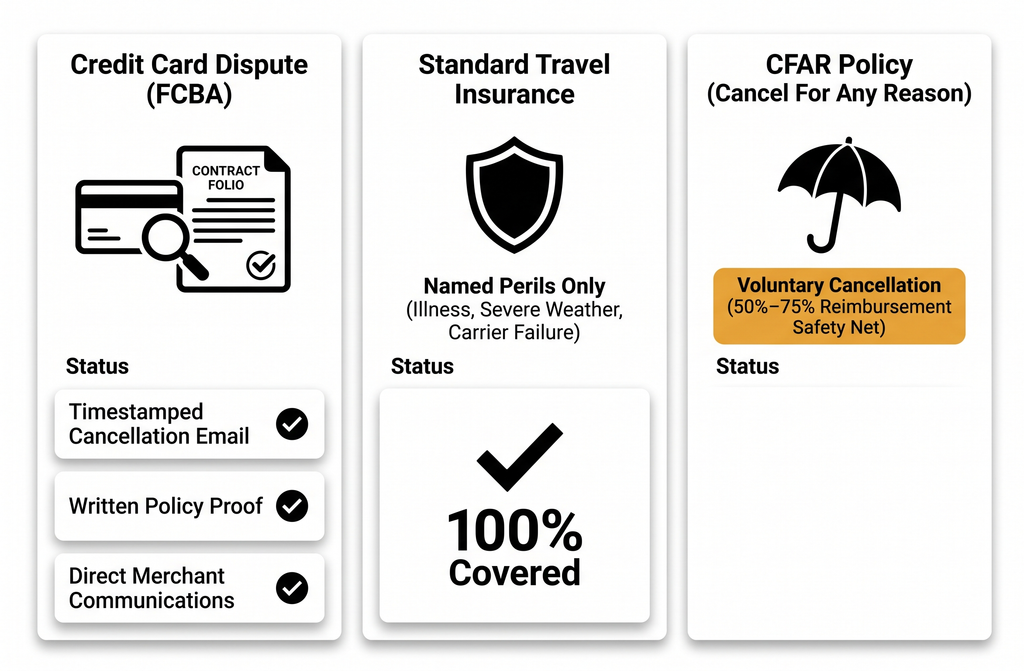
However, initiating a chargeback is not a guaranteed remedy and must be approached with analytical precision. To win a chargeback dispute regarding a hotel cancellation, the traveler must present clear documentary evidence that they operated within the bounds of the agreed-upon contract. This evidence should include the original reservation confirmation showing the cancellation policy, time-stamped cancellation email receipts, or records of communication with hotel staff agreeing to waive the fee. If a traveler attempts to dispute a clearly marked “non-refundable” rate simply because their travel plans changed, the credit card issuer will almost certainly rule in favor of the hotel, as the merchant fulfilled their contractual obligation of holding the inventory available.
For scenarios where travel is disrupted by medical emergencies, severe weather, or other unpredictable crises, standard consumer protection laws offer limited recourse. Instead, travelers must rely on travel insurance products. Standard travel insurance policies cover cancellations only under specific, named perils—such as severe illness, jury duty, or carrier-initiated flight cancellations. To obtain complete flexibility, travelers must purchase a Cancel For Any Reason (CFAR) policy. CFAR coverage is significantly more expensive and typically reimburses only 50% to 75% of the non-refundable trip costs, but it provides the only true financial safety net for voluntary cancellations outside the hotel’s standard policy windows.
Additionally, regulatory oversight from bodies like the Federal Trade Commission (FTC) focuses heavily on ensuring transparency in travel pricing. This includes monitoring deceptive booking paths where cancellation terms are hidden behind ambiguous links or obscured by high-pressure sales countdowns. While regulatory action helps shape long-term industry standards, individual travelers must remain proactive, documenting every step of their transaction and treating the booking confirmation as a critical legal contract.
Bottom Line
- Credit card chargebacks require documented proof of compliance with the cancellation contract to be resolved in the traveler’s favor.
- Standard travel insurance only covers specific named perils, while Cancel For Any Reason (CFAR) policies offer broader but partial reimbursement.
- Regulatory protections combat deceptive practices, but individual contract terms remain the primary legal authority in cancellation disputes.
Strategic Optimization: Balancing Flexibility and Cost
A systematic approach to travel booking involves actively managing reservation portfolios to maximize flexibility while controlling total capital expenditure. Rather than viewing hotel booking as a static transaction, highly analytical travelers treat it as an ongoing optimization process.
One highly effective strategy is rate tracking and active re-booking. When planning a trip several months in advance, booking a fully refundable rate secures a room at a guaranteed ceiling price. As the travel date approaches, hotel occupancy patterns change, and properties may lower rates to fill remaining inventory. By periodically monitoring the hotel’s direct pricing, a traveler can easily cancel their original refundable booking and immediately re-book the same room at the lower rate. This technique allows travelers to capture the benefits of dynamic pricing without exposing themselves to the risks of late-stage inventory shortages or price spikes.
In cases where an unexpected emergency forces a cancellation outside the free window for a non-refundable booking, appealing to property-level management remains a viable, albeit non-guaranteed, strategy. When contacting a hotel, travelers should bypass national corporate reservations lines and speak directly with the on-site front office manager or general manager. Rather than demanding a full refund—which the hotel’s policy may strictly prohibit—it is often more productive to propose alternative solutions. For example, asking to shift the reservation dates to a future window, or requesting a property-specific credit voucher valid for twelve months, preserves the hotel’s captured revenue while protecting the traveler’s capital from a total loss.
Finally, travelers must understand the operational risk of over-booking and the industry standard “walk” policies. Just as airlines over-sell flights, hotels routinely book more rooms than physical capacity allows to protect against the statistical probability of no-shows. If all guests arrive, the hotel must “walk” the excess guests to a comparable nearby property. Under standard industry contracts, the walking hotel is obligated to pay for the first night’s lodging at the new property, cover transportation costs to that location, and ensure any pre-paid deposits are fully accounted for. Recognizing this policy ensures that travelers facing an over-booked situation can clearly assert their rights and avoid paying twice for displaced accommodations.
Non-Obvious Reservation Red Flags
When auditing the terms and conditions of a prospective booking, travelers should look for specific language patterns that signal elevated cancellation risks:
- Mandatory, Non-Refundable Cleaning or Resort Fees: Some properties disclose that while the base room rate is refundable, specific administrative, resort, or cleaning fees are charged immediately upon booking and are entirely non-refundable.
- Vague Force Majeure Clauses: Standard contract templates often define acts of God broadly, allowing hotels to cancel reservations due to weather or labor disputes without providing monetary refunds, offering only restricted future credits instead.
- Third-Party Name Change Restrictions: Many low-cost bookings strictly prohibit transferring a reservation to another individual, preventing travelers from selling or gifting their room to a third party if they cannot make the trip.
Conclusion
Securing value in the modern travel ecosystem requires moving past the simplified marketing of booking platforms and adopting a rigorous, analytical approach to reservation contracts. Every booking represents a calculated trade-off between the premium paid for flexibility and the risk of capital loss. By carefully calculating local time zone deadlines, understanding the structural differences between direct and third-party bookings, and utilizing credit card and insurance protections systematically, travelers can navigate cancellation rules with confidence. Ultimately, establishing sustainable travel habits relies on thorough contract auditing and intentional capital allocation rather than relying on loopholes, guarantees, or customer service exceptions.